Welcome back to Living the Could Life. Today, we’re going to talk a little bit more about traveling with the food that you may need for your health conditions or for your nourishment when you travel. I’m Teresa.
Theresa:
Since the last time we talked, I’ve been thinking about food and the cooking gear and what we might take for our next trip. And honestly, it’s a little bit overwhelming. Well, Robert’s now on a vegan diet, so that will be something very new for us.
And there’s a difference if you are traveling totally by car, if you’re backpacking, if you’re flying and changing hotels every day. There’s a whole lot of different ways. Don’t assume that just because you have some type of later-in-life disability, you can’t still travel, you can’t still backpack.
You just have to adjust.
Theresa:
I agree. Now, let’s walk through how that system changes, depending on whether you’re taking a plane, a car, backpacking, or actually a mix.
Theresa:
First, I recommend starting with the non-negotiables. Stove and fuel. If you’re backpacking, unless you’re flying, then you can’t pack the fuel.
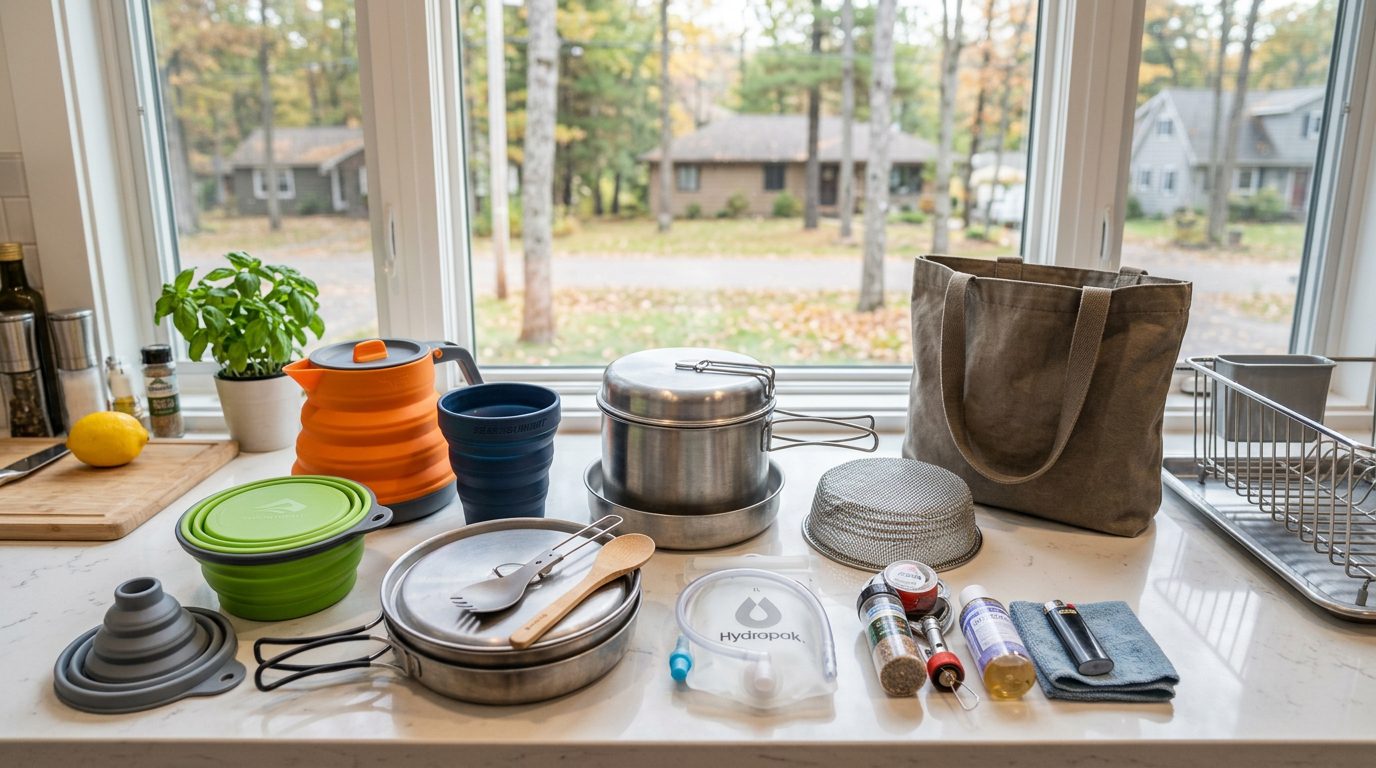
A pot with a lid, and that’s good for anybody. They make collapsible pans. I know one of my essentials is a collapsible tea kettle, because I find that I don’t like making tea in a coffee pot that’s had years of coffee buildup in it.
And also, after having read about the woman who used the coffee maker to wash her underwear, I would just rather carry my own. And fortunately, it works on both currencies, like here in Europe. So everybody will have something else that they need to carry, maybe a tiny cutting board, a collapsible sink.
There are tons of things, and I think both space and weight are considerations.
Theresa:
Right. And I know you like the collapsible things as well, since you get to carry a lot of it, and they’re so much easier to pack. Let’s talk about plane travel.
Theresa:
You have to think of planes as minimalist mode. They restrict so many things. You can bring solid foods, collapsible bowls, utensils, and some spices.
But if you need fuel, forget it. And you can not have sharp knives in your carry-on, but you can pack them in your checked luggage.
Theresa:
Oh, you still have options. So you could pack like a plastic or ceramic travel safe knife. You can plan meals that don’t require cutting.
You can find a cheap knife somewhere when you land.
Theresa:
Perishables? Well, unless it’s something that you need, you know, to keep you healthy and safe, wait to buy them after you land. And that’s if you need fuel to cook or heat things.
You don’t know where you’ll be. You don’t always know if your hotel has something to heat food or anything like that. Another reason that I carry my tea kettle, it could heat up water for other things as well.
Even if you are flying just with a carry-on, just think about what you could buy and then, you know, maybe leave it. If people still stay at hostels, it used to be popular to leave your food and utensils and anything you couldn’t take on the plane at the house.
Theresa:
Yeah, it’s a game changer before you panic. Oh, my God, I need a knife or I need this or that. Try to think about it and what other options could be.
And I’m a big user of A.I. and we can get into that a little more in this discussion. But you can also get dehydrated meals. They’re good for backpacking, but they might also be good for other digestive or health conditions that you have.
Theresa:
Yeah, they are. I mean, weight doesn’t matter. So you can, depending on if you have a full car or not.
I remember our trip to France, our car was pretty full, but we still did fit in some of our comfort items. Like I had, of course, my kettle. You could pack cookware.
They still make, you know, modern day mess kits. You need water. And I guess just remember that it’s your vacation.
So think about how much you really want to cook if you don’t need to. If that’s the case and you don’t need this for health reasons, you can wait and buy all your food and supplies when you get to your destination. So even if you have a car, maybe you don’t want to carry everything in your car from the start.
You just have a lot more options because you don’t have weight limits in your car. You can have an ice chest. You can keep your medications cool.
Anything like that.
Theresa:
Right. And really, it’s nice because redundancy makes some sense in that case. You can take extras of what you need, extra backup cutting board, or in case you don’t have water or a good place to wash some things, you could take extra dishes or things like that.
So it’s just really convenient. But you just have to be sure that you don’t pack everything, including the kitchen sink. Really, everything’s right at your fingertips.
Theresa:
That’s true. And we’ve also done bicycle touring, which I guess is similar to backpacking, at least having to carry your life with you. You have to use multipurpose items if there’s more than one of you.
And this is true of travel, too. Split some of the things up so somebody’s not carrying the tea kettle, the pot, the silverware, etc. And, you know, take along like a spork.
That’s a good multi-use tool. And maybe a cutting mat because you never know, you know, what’s been on counters or how clean they are. They do make collapsible containers.
So those are nice, too. What about food? Well, especially for like backpacking, you can take dehydrated meals, depending on how far you are away from supplies.
Everybody’s not doing some wilderness backpacking trip. Maybe you’re just doing a few miles a day.
Theresa:
That’s something to buy after. You can buy it if you arrive by a car. But of course, if you want to eat and you have food that requires eating, you definitely want to have fuel.
And if you have the room, you can always have a backup. But you always have to worry if it’s windy or cold because you’ll use more fuel. So just plan ahead and know what you’ll need.
Theresa:
Planning is very important. And don’t wait until the day before your trip.
Theresa:
Well, like we said before, no knives, no big scissors. Carry the kids scissors. Those usually will pass through and just go to the local, what they used to call the five and dime store.
You know, but there’s all these or something similar to Dollar Tree or Walmart or Target. OK. You’ll find something wherever you stay.
They can recommend something for you.
Theresa:
I mean, you should bring what you need, especially if it’s for your health. So that’s different than I’ll just bring this and that, these snacks and that. If it’s essential to your diet, bring at least, I would say, a 48 hour supply in case a flight delays or something like that.
I mean, if you have hypoglycemia or need to have some other kind of energy, carry that with you. If you do bring things in bags, it should be shelf stable. And sometimes look for what they pack for kids because, you know, just think of like juice boxes and things like that.
They’re pretty well sealed. You don’t have a big bottle. Don’t bring on fresh foods.
Theresa:
Basically. And of course, if you are staying somewhere with a kitchen, which more and more we try to do, even if we have leftovers, if we’re in visiting a place where it’s not frowned upon to bring leftovers or just if we want something cold to drink or whatever, we stop and see something a farmer’s market, we can put it in our fridge and then save it to eat later.
Theresa:
And that is when you really need to do your research. Let’s say you need something like Ensure. Find out what could be similar at your destination.
There may be somebody who can deliver. If you’re at a hotel or like an Airbnb or Verbo, sometimes they will get groceries for you. They may know, oh, here’s the store that has Ensure or protein bars or whatever it is that you need.
I know of cases where somebody’s grandchild needed a certain kind of nourishment and that was difficult to find. So in that case, there are companies who will ship your luggage. So say I needed a lot of Ensure for my trip and couldn’t find it where I was going.
I would pack it up, get in touch with the first hotel where I’m staying, see if they will accept packages and go from there. But there are also like Amazons in certain countries, so they might have what you need. You could use one of those luggage services.
I don’t think they restrict. However, when it’s liquid, that’s a different story. So check with those.
And you really have to be creative.
Theresa:
Exactly. And then you can make a decision tree. I will put that in the show notes.
So it’s kind of like an if then. If they don’t have this, then do that. If they do, go this way.
I’m sure you’re familiar with that.
Theresa:
Like I said, you know, find out. Maybe you can’t ship what you need internationally. Find out what’s comparable to it.
Ask your health care provider if there are any other alternatives that you could use. And then, like I said, you could ship it to the hotel. But just be sure that they do accept packages.
I know a lot of places we stay, it’s an address to stay. It’s like an Airbnb. So people aren’t always there.
So you wouldn’t want it sitting somewhere. There used to be International Mail Drive. What was that called?
Theresa:
Yeah, Posto Riposo. Which in English is, oh, what do they call it? We did it on our bicycle trip so that we didn’t have to carry too much.
Theresa:
Right. You could send it to a certain post office, show your ID and pick it up. So that was very nice.
And there are some people who will haul your luggage for you. So you could also find a service like that. And I will put, like I said, I will post along with some prompts that you can ask AI.
There may be something like the Amazon Locker where you’re visiting. So that’s another thing to ask.
Theresa:
It is. So it could be Amazon, Lockers, UPS, DHL and places like that. Depending, again, on your locale.
You ship your safe foods there and not just your safe foods. I mean, it’s good the ones that, you know, agree with you and your system and contribute to your health. And you especially want to be healthy while you’re traveling.
Theresa:
Well, like I said, then you can see, you know, if you could order online or call a local store and see if they can deliver it for you. We shop at Aldi, but there’s Amazon, like I said, and there’s like Carrefour and Aldi and Lidl and Tesco. All different types of stores in different countries.
It’s up to you to research. And I don’t know if there’s any forums because I don’t usually have to take food, but maybe somebody has suggestions. And actually, if there’s something you do, we’d love to hear about that.
Theresa:
That’s when it gets really tough. And that’s kind of like the last straw for you. But mostly people do find some type of solution or maybe they don’t travel as far away or they change their destination to where they can get that.
It’s not as if people in your hometown are the only ones who need high protein meals or other types of nutrition.
Theresa:
Right. And that’s always an option. Often we see people at the airport with lots and lots of luggage.
And of course, it’s one of those taxes on people who have special dietary issues or certain disabilities. You’ll have to pay for the extra baggage fees or maybe not if you have a credit card because you can get some free luggage, especially on international flights. And I guess one thing, like we said, we’re going to Italy soon.
And Robert mentioned last time, and you can talk about it again, is about Italy. They’re kind of progressive as far as dietary needs.
Theresa:
And say you are gluten free. Be sure you bring two days worth of emergency food just in case. But also research.
What can you find in Italy? Where do you go? Is it a specialty store?
Is it the general neighborhood store? Do they sell it in pharmacies? Same with the supplements?
Do your research first. AI can be helpful in that case. Again, I’ll put that in the show notes for you.
So maybe you don’t spend as much time. I think one thing that we’re both learning is besides what they call the disability tax, you need extra time to do things.
Theresa:
Of course. So picture this for your kit. And again, you have to consider how much space you have and weight and all of that.
Consider a collapsible cup, maybe a collapsible sink if you don’t want to use the sink at your hotel. A pot with a lid. A tiny pan.
A spork, which if you don’t know, that’s a spoon or fork on each end. I would wait and buy a knife when you get there, but a cutting mat might be good just to be sure that the surface is clean. And you might want to take a small oil bottle.
You can pack that as long as it’s less than three ounces. As long as it’s less than three ounces. Depending on where you go, maybe in Italy you will find a small bottle of olive oil somewhere.
And you can take some spices you like and again, pack them into something smaller because it’s unlikely that you will use an entire jar of spices. You might want to carry matches or get some when you arrive. If you’re backpacking, you know, it depends again if you’re flying or driving.
Theresa:
We like to take trash bags and if we go shopping, we keep them. They’re great just to have a place for garbage because often you get a little garbage can in your room. And it’s good for dirty laundry as well and other things.
Theresa:
I think it does.
Theresa:
Yeah, like I said, you really have to plan ahead. Don’t wait to the last minute. It’s almost like packing medication.
Be sure you have all that. The goal of this is to feel more confident. So once you understand the constraints, whether you’re on a plane, in a car, or backpacking, or bicycle touring.
And we did bicycle with a gentleman who I believe he had celiac, gluten-free, hypoglycemia, and he did it. So when he was prepared. So you just have to know your limitations and be ready.
Theresa:
And you’re probably ready to eat well while traveling and you’ll get to try some new foods with your new vegan diet.
Theresa:
Me either. Thank you for joining us today. We will see you at Living the Could Life next week.