Robert:
Welcome back to Living the Could Life: Real Travel for Real Bodies.
If your body changed before you were ready, but you still want to see the world, you’re in the right place.
We talk about accessibility, mobility, energy, and joy, because travel isn’t over. It’s just different.
There’s still so much of the world to enjoy. I’m Robert.
Theresa:
And I’m Theresa.
Today we’re talking about how we’re using AI to plan our upcoming Italy trip, and honestly, we’re still planning. One thing we’ve learned is that travel planning with AI isn’t a one-and-done process.
You’ll ask an initial question, get some ideas, then think of something you forgot to mention. Your priorities might change, or you’ll discover a new possibility that sends you down a completely different path.
That’s actually one of the strengths of AI. You can keep refining the conversation as your plans evolve.
Robert:
So today’s episode is a practical one. Let’s start with the prompts you used.
Theresa:
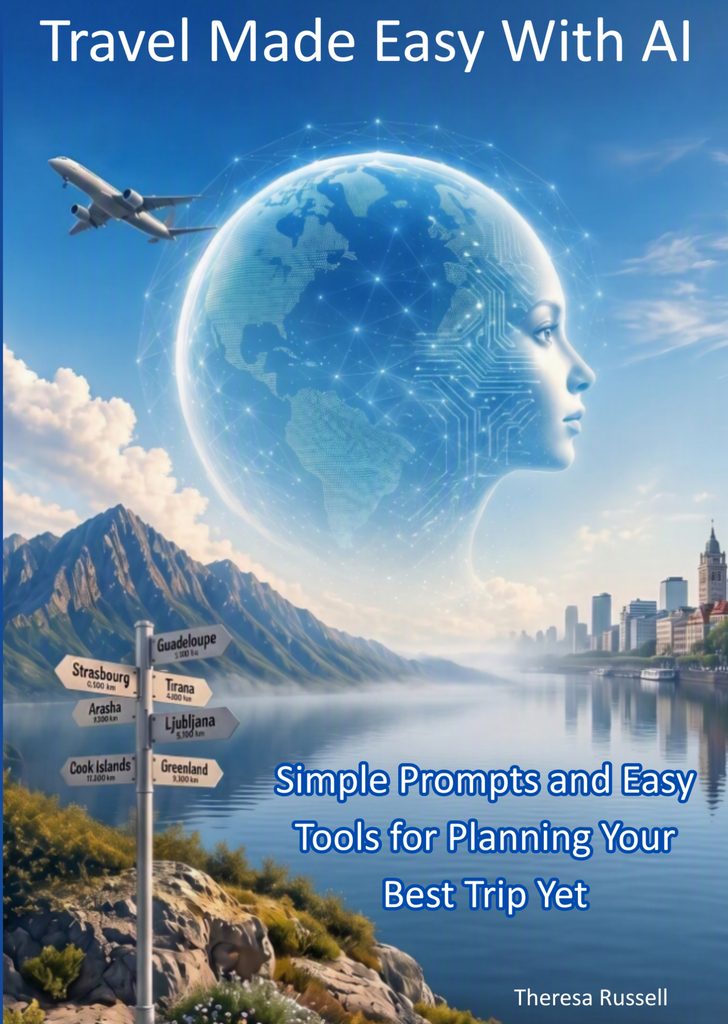
If you’re new to AI travel planning, don’t feel like you have to figure it out from scratch. We included sample prompts in my book, Travel Made Easy with AI: Simple Prompts and Easy Tools for Planning Your Best Trip Yet.
The book is very hands-on. I like learning by seeing examples and following along step by step, and that’s how it’s designed. You can work through the entire process or simply jump to the chapter that solves the problem you’re working on.
For this trip, I started with a simple request:
“I’d like to visit Italy. What smaller destinations should I consider?”
We weren’t interested in the usual choices like Rome, Venice, or Florence. We wanted something a little different.
We knew we’d likely fly into Milan because I found a good airfare using Delta points, so that became our starting point.
From there, I asked several AI systems for suggestions, and interestingly, many of them recommended similar destinations, with a few variations.
Robert:
That makes sense. If you ask a broad question, you’ll probably get a broad answer.
Theresa:
Exactly.
The more general your prompt, the more general the response. It’s a lot like walking into a travel agency and saying, “I want a trip. Where should I go?”
Without knowing anything about your interests, budget, mobility needs, or travel style, nobody can give you truly personalized recommendations.
As you continue the conversation, you can start adding details.
For example:
“Which smaller Italian towns work well for a hub-and-spoke trip with easy access to castles?”
Or:
“Which destinations have apartments or hotels with kitchen facilities, elevators, and good public transportation?”
The more information you provide, the more useful the recommendations become.
Robert:
And once the conversation starts, you can keep refining it as much as you want.
Theresa:
Exactly.
One thing AI did well was helping us narrow down destinations by asking follow-up questions.
Do you want to stay in the center of town or outside town?
Do you prefer trains or rental cars?
Do you want mountain scenery, historic cities, or food-focused destinations?
As we answered those questions, our itinerary started taking shape.
Another area where AI helped was accommodations.
Because of my mobility needs, I’m always looking for elevators. We also prefer having a living area instead of being confined to a single hotel room.
Over time I’ve learned that asking for kitchen facilities often produces better results than simply asking for apartments.
We’re not looking to cook elaborate meals on vacation, but having a refrigerator, microwave, cooktop, or basic kitchen equipment lets us reheat leftovers, store food, and travel more comfortably.
Robert:
And we’ll be staying in one location for almost a week during this trip, so having those facilities will be even more useful.
Theresa:
Absolutely.
Laundry facilities are another priority because they allow us to pack less.
As AI generated suggestions, we gradually eliminated destinations that didn’t fit our needs. Some lacked suitable accommodations. Others had major events taking place that reduced hotel availability and increased prices.
That’s another great question to ask AI:
“Are there festivals, conventions, sporting events, or major gatherings happening during my travel dates?”
Robert:
Because those events can affect transportation, too.
Theresa:
Definitely.
I remember being in Ireland after a football match and finding ourselves on a train packed with enthusiastic fans.
Experiences like that are fun, but they also remind you that local events can have a big impact on your travel plans.
Eventually, after several rounds of questions, comparisons, and revisions, we settled on a tentative itinerary:
We’ll fly into Milan, travel to Parma, stop in Verona, continue to Bolzano in the Southern Alps, then visit Bergamo before returning to Milan for our flight home.
Of course, that’s still subject to change.
And this is where human judgment becomes important.
Robert:
AI is a great planning tool, but sometimes you have to override its recommendations.
On paper, a bus route may look convenient. AI may say public transportation is available.
But once you check schedules, travel times, transfers, and accessibility, you may discover that a rental car or a different route makes more sense.
That’s why it’s important to verify the details.
Theresa:
Exactly.
The same thing applies to restaurants, attractions, and accommodations.
AI might recommend a restaurant and say it’s a “must-visit,” but AI hasn’t actually eaten there.
When I began reading reviews, I found one highly rated restaurant that hosted lots of large family celebrations, wedding events, and group gatherings.
It sounded wonderful for a special occasion, but not necessarily the intimate dining experience we were looking for.
The recommendation wasn’t wrong. It just wasn’t right for us.
The same goes for castles and historic sites.
We’ve learned to verify opening hours because some properties may only be open for private events or special occasions, even though they appear open online.
Robert:
Reviews can help with that.
Just remember to look for patterns instead of focusing on one opinion.
Theresa:
That’s a great point.
Reviews often reveal details that AI misses.
Sometimes you’ll find comments about noise, accessibility challenges, difficult parking, steep staircases, or other issues that don’t always appear in AI-generated recommendations.
When we’re seriously considering a place, I usually read a lot of reviews because that’s where those small but important details show up.
Robert:
And if multiple reviewers mention the same issue, it’s usually worth paying attention.
Theresa:
Exactly.
So our biggest lesson from planning this Italy trip is that AI works best as a travel assistant, not a travel agent.
It helps you generate ideas, compare options, and save time, but you’ll still need your own judgment to make the final decisions.
Next week, we’ll continue this series and share some of the more advanced questions we’re asking AI, along with a few surprises about what it can and can’t reliably answer.
Thanks for joining us on Living the Good Life.
We’ll see you next week.