Robert:
Welcome back to Living the Could Life. Real travel for real bodies. If your body changed before you were ready, but you still want to see the world, this is the place for you.
We talk accessibility, mobility, energy, and joy. Because traveling isn’t over, it’s just different. There’s still so much travel you could do.
I’m Robert.
Theresa:
And I’m Theresa. Today we are talking about our personal experience, and what could be yours too, about traveling to Mexico for dental work.
Robert:
Let’s start with the why. Many patients consider Mexico for dental treatment because procedures can cost significantly less than in the United States, while still offering access to modern clinics and experienced dentists. What would you do if you could save thousands of dollars on major dental work while enjoying a short getaway?
Theresa:
Well, we considered just that, and there were three of us who needed dental work.
Robert:
Well, actually two of you in the beginning.
Theresa:
I guess there were two, and Robert was iffy, and as was I. I mean, I had a crown glued in, and the dentist is like, well, do you want to have the crown replaced now, or should I just glue it? And, you know, knowing that it could last two weeks, or two years, or longer.
And I said I would just get it glued in because of the $1,900 cost of a completely new crown. And she said, well, just save up the money, and really $1,900, I could do something a lot better than get dental work. So we started discussing this.
Robert:
And then for me, I recently went to my dentist for a cleaning and checkup, and he had just expanded his dental office, and he had a couple of younger dentists who had begun working for him. And I had seen each of them, and one of them said I needed a couple of crowns. The other one said I needed five surfaces redone on three teeth.
And then when I saw my original dentist in the practice, he said, no, you look pretty good. We can just sort of wait and see. And right now, maybe the other dentists were just a little too aggressive.
And so I thought, hmm, okay. I wasn’t in any pain, and so I thought, okay, we can wait and see.
Theresa:
And having traveled in the past, and having had crowns fall off, once after I bit into a grapefruit, another time in Columbia, which I happened to be able to find a dentist, but I was concerned about my crowns. And then our son was going with us, and he needed significant dental work, and we just sat down. Actually, we had talked about this even before.
I was also told I might need another root canal. I recently had one that was several thousand dollars, not including the crown.
Robert:
And we had traveled through Mexico several times before, and our son had also been with us on some of our trips. So we were very comfortable visiting Mexico.
Theresa:
So the first thing you need to do is determine your needs, which we pretty much did. And we knew what we needed.
Robert:
Before comparing clinics, understand exactly what treatment is needed. Options may include implants, crowns, bridges, dentures, veneers, root canals, or full mouth restoration. So think about it.
Do you need a simple procedure? Are you facing extensive treatment that could benefit from dental tourism?
Theresa:
And that also makes a difference depending on where you live. For us, we do not live close to Mexico, but we did meet some of the people at the clinic we went to. They could just drive a few hours, and that makes a big difference because there was a significant savings even for something as simple as a cleaning.
But then again, you have to consider the cost of gas and parking and time and all of that. So most people who flew in or drove in, they were having more extensive work done than something simple like gluing a crown back in or having…
Robert:
So one of the first things you need to do is gather your records and estimates. Collect your x-rays, treatment plans, and quotes from local dentists. These become the foundation for comparing treatment options abroad.
And I need to say here that my dentist and the staff were very supportive of our going to Mexico to get work done. And we had no problem getting x-rays, copies of x-rays sent to us so that we could send them to the Mexican clinics. And they understood.
Theresa:
Right. In fact, I asked my dental hygienist if I would be kicked out or banned from returning if I had some of my work done in Mexico. And honestly, just one crown at $1,900 was worth it for me to go.
But there’s a little more to that story that will come later. And your dentist cannot refuse to give you your dental x-rays and records.
Robert:
Okay, you need to research clinics carefully. Not all clinics in Mexico are the same. Focus on credentials, patient reviews, technology, years in practice, and communication quality.
And think about would you choose a clinic based solely on price or would qualifications and patient experiences matter just as much?
Theresa:
Something else that we looked into is what kind of access do they have to a lab? How quickly could they get the work done? What kind of qualifications do they have?
How long they’ve been in business? Who’s on their staff? Ours had dentists, I’ll get periodontists, endodontists, you know, a lot of specialized, you know, trained beyond a dentist who could do root canals, implants.
There’s something called a four-on-one, which I’m still not sure what that is. I think it’s a lot of implants. There’s some who did veneers.
There’s some who do services for kids like braces and just child dentistry. So you need to select who you think would be the best fit for what you need to have done.
Robert:
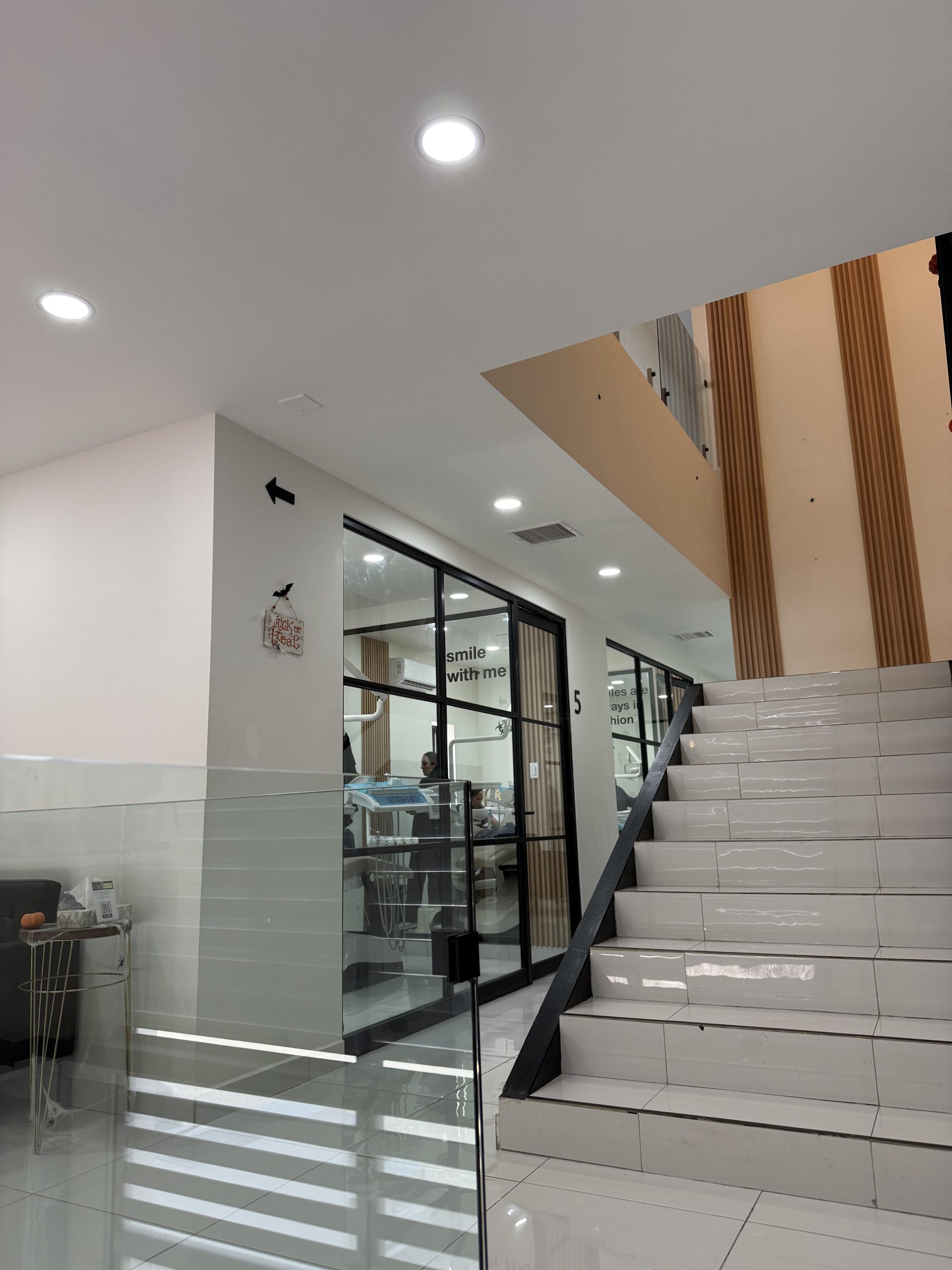
The clinic that we chose in Mexico, I was very impressed by when I first saw it. It was a building that was purposely built for doing dental work. It had three floors and first floor was basically examination and then the second and third floor were for doing more serious work.
It had a dedicated waiting area, had the receptionist area. So it was a very new building, very clean, very well organized, and everything ran very efficiently.
Theresa:
Right, they’d obviously done this before. When Robert mentioned the cleaning, they were constantly cleaning. It was a very modern building.
However, there were a few things missing. They did have a ramp outside and I don’t speak fluent Spanish, so I asked the driver. They also provide shuttle service from the border to the clinic, which was nice.
And I, on one of my treatment days, I asked for a ride back to my hotel. I have vision loss and Mexico is often difficult to navigate. So I asked him what do they do because they do not have an elevator.
On the first half of the stairway to the second floor where I had to go, they had a handrail. After the landing, there was no handrail, but people helped me navigate that. But that’s just something to know and I asked the driver, you know, especially since we, you know, part of our mission is to help people with later in life disabilities and many of the clients there were later in life people still caring about their dental health.
Several had walkers or mobility aids. Now the driver told me, and I didn’t verify this, this was the last day, that if you can’t do the steps, they will do your work on the first floor, which is where they start your initial exam. But that’s something to consider.
There could be clinics that do have elevators. So check into that if you want to be sure about that and ask what they could do. And I guess I was a little surprised because it was a purpose-built building that they didn’t consider the elevator.
Robert:
Another thing to consider is to request multiple consultations. Most reputable clinics offer virtual consultations. Comparing several providers can help identify the best combination of care, value, and comfort.
So what questions should you ask during a consultation to feel confident in their decision? Some suggested questions are, what are the dentist’s qualifications? And we found that many of the dentists were actually educated, trained in the United States.
How many procedures like mine have they completed? What technology is used? What warranty or follow-up policies are offered?
Theresa:
And I will say too, our clinic was ADA, American Dental Association certified, or I don’t know what the what kind of designation you got. All of the dentists I met with were very professional, very efficient. There was also a, I don’t want to say a warehouse, a place that could help you.
If you do a Google search or ask AI as I did, that can direct you to clinics. But I think it’s a membership-based referral kind of service. I just searched the web, read the reviews.
I like reviews that are usually about four star. And I look at how many people have left reviews. I’m kind of anal about that, but I chose one.
And I think in general we were satisfied. The technology they used, I think some of it was better than what we have at home.
Robert:
I think we were very satisfied. One of the things we haven’t mentioned yet is that everyone spoke fluent English. So there was no language barrier at all if you don’t speak Spanish.
Theresa:
And that was a good thing. And I would say most of the clientele were English speaking, although there were some locals too.
Robert:
Yes. And Teresa mentioned earlier that most of the patients were later in life. There were a few people who were earlier in life in their 20s and 30s that were going in for work too.
That’s true. And our son was there too.
Theresa:
Yeah, we kind of made a family trip of it. And one advantage of that is we didn’t each have to get a separate lodging space. And we’ll talk about that in a little while.
Robert:
And our work did come with a warranty. If you go and have it inspected by the same company on a yearly basis, they guarantee the work for two years. And some places had longer warranties.
Theresa:
So that’s something else to check into. And the consultations, they can be free. Initially, Robert wasn’t going to have anything done.
But I said, you know, since you’re here, why don’t you just get checked out?
Robert:
And especially since I had gotten three different opinions in like the last year about what I needed.
Theresa:
Right, why not get a fourth?
Robert:
So yeah, so I got a fourth. And the dentist who did my exam said, yes, I did have one crown, or one tooth that needed a crown. And he poked around and said, yeah, we really shouldn’t let this one go.
And then he was very concerned about my lower teeth. I apparently do grind my teeth. And that my lower front teeth had been worn down way too far.
And he said, those should really be capped. And so I said, okay, that’s going to mean that I need five crowns or four caps and a crown. And I said, okay, all that work would have been less than the cost of a single crown, about half the cost of a single crown.
So but when I got up to the dentist who is going to actually do the work, she was a little bit concerned about doing my lower teeth. And she said, probably should wait on that. And she said, you do need definitely need the crown up top, but we’ll wait on those because my overbite was so extensive.
She said, this is going to really require a little bit more work. And so and she said, I don’t need that done immediately. So I was kind of pleased or satisfied with that.
There was kind of a, almost like a second opinion involved in the process. And so I just got the single crown done.
Theresa:
Right. And I guess since you’re talking about the process, we can talk about that a little right now. First, we went to a reception in town.
And I thought that was the clinic, but no, it was downtown. The clinics were farther away, which actually turned out the clinic, they had said it’s like only a block from our hotel, but it was far longer than that. Well, not far as probably five blocks.
When we went to the reception, we thought that was the clinic. So they just kind of register you and do all that. And then they have their driver who takes you to the clinic itself.
So we waited there. And then once you go in, we had set our appointments up in advance, just give them your name, you go to see, I guess, the incoming dentist who checks you out, takes x-rays, and tells you what you will need. So even though they’ve looked at your dental x-rays that we sent in advance, they still, you know, they’re not just going to trust somebody else’s opinion, I guess.
Or I thought it was really good that they redid them and looked them over. And for me, I expected one crown to complete the tooth that had the root canal. And then I had another questionable one, which at home they said could be another root canal.
And they said no, it wasn’t. And then they offered me a choice of a type of crown I could have. I didn’t even know there were different types.
And they were not pushy. I felt they’re honest. They pointed out everything.
They said, oh, look at this crown. And I also am a Bruxer. So I had worn some of the porcelain away from my crown.
So they said, see all this black stuff and blah blah blah, that’s worn away. Then they said, really, you need 10 crowns. I’m like, what?
But since I was there and I could get four crowns for the cost of one at home, and that was the nice zirconium crown, which I didn’t even know existed. I’d always gotten the metal crowns. So I splurged and went for that.
Plus I had a cleaning and got a mouth guard because their mouth guards are a hundred bucks. They do it right there because they have a lab. You see the couriers going back and forth all day to make the crowns, get mouth guards, do whatever they need to.
Robert:
It was very interesting. I had my prep for my crown done in the early afternoon and I had a temporary. And then I went the next day, the next morning, and my finished crown was ready to be installed.
And so it was just like an overnight thing. And then I got a mouth guard too, a night guard, and they took the impression early in the morning. And then a couple of hours later, it was back.
And so very fast, efficient service.
Theresa:
Let’s go back to the planning stage again. I guess we both go off on tangents, but that’s okay. You know, try to understand the treatment timeline.
And that was difficult for me. I had asked like AI, how long should this take? And what they said was a little bit different than what I did.
So it was very hard when we made travel arrangements. We actually ended up leaving earlier. I thought just with one crown, it would take a while.
And our son needed an implant. And with implants, you do have to return. So that’s something to keep in mind.
Robert:
He has to return in six months, I think. He has to let the bone develop enough so that they can insert the implant.
Theresa:
After having done this, I’m kicking myself. I’ve had three implants and it’s probably been at least 10 years. They were $7,000 each.
And that’s really not what I want to spend $7,000 on. And I was not happy with the last one that I had done. I didn’t think it was formed correctly.
And it now traps food. And it’s a pain. But I hadn’t even thought about going elsewhere to have it done.
I mean, for $21,000. And I will say Mexico is not the only place you can go to. Turkey is popular.
You can go to, I think, Southeast Asia. You’d have to look that up. So you could make it a vacation.
We had limited time. So it wasn’t much of a vacation. But it was still good.
So anyway, the timeline, they could have gotten us in the next day. But there’s no way that we could have flown out the next day. And they’re really good.
They also gave us an estimate. But I’m getting ahead of myself again. And I think we have so much more to say about this that we are going to make this two parts.
So thanks for listening. And we’ll be back next week with part two with probably some more scattered recommendations for planning this kind of trip. And we’ll start with how to budget for it.
Robert:
And how to choose the right destination. And what else?
Theresa:
Yeah, flights and accommodations. There are some considerations. They will do their own consultation.
You don’t just say, hey, I need this, this, and that. And they’ll tell you about recovering, how everything will go. They’ll send you an estimate.
And we’ll discuss that the next time. Thanks for joining Living the Could Life.
(Transcribed by TurboScribe. Go Unlimited to remove this message.)
(Transcribed by TurboScribe.)