Theresa:
Welcome to Living the Could Life. Today we are talking about designing a special space for your 70-day workbook. And that’s having comfort, accessibility, ritual, and renewal in mind.
I’m Theresa, and today we’re talking about something that’s gentle, practical, and surprisingly powerful. And that is creating your own personal and special space for working through your 70-day workbook.
Robert:
And I’m Robert. This episode is especially for people navigating late-in-life disabilities, folks who are learning new rhythms, new limits, new ways of caring for themselves. We’re going to talk about how a small, comfortable, predictable space can support that journey.
Theresa:
And both of us are on that journey with our later-in-life body disruption. So we thought it would be a good idea to go over exactly how having a dedicated space can help. And we want to cover the science behind the dedicated spaces, how to set one up even on a tight budget, how to refresh old items so they feel new, and how to use simple rituals, even like a change of clothes, to help your mind shift into a calmer, more focused state.
Robert:
Let’s start with the why. Environmental psychology tells us that consistent physical cues help the brain transition into focus. When you sit in the same place every day, your body learns.
This is where reflection happens.
Theresa:
It’s kind of like the Pavlovian response. It is habit-forming in the best way, so you don’t need to drool like those dogs did. And the dedicated space reduces decision fatigue.
You don’t have to wonder where to sit or what you need. You don’t have to make any kind of decisions because it’s already set up. That predictability is very grounding, especially when your body or abilities have changed.
Robert:
Here’s a quote I like. Space is the cue. Routine is the bridge.
Your space cues the behavior. Your routine carries you across the days.
Theresa:
And for people adjusting to a new disability, that sense of stability can be deeply comforting. It’s not about perfection. Remember that Voltaire saying.
It’s about creating a place that welcomes you, supports you, and makes your work feel doable.
Robert:
Let’s talk about the basics, the core elements of a comfortable, accessible workbook space.
Theresa:
Here’s what most people need. And I said most, so we are not just a monolithic group of people. So we all have our own particular needs and preferences.
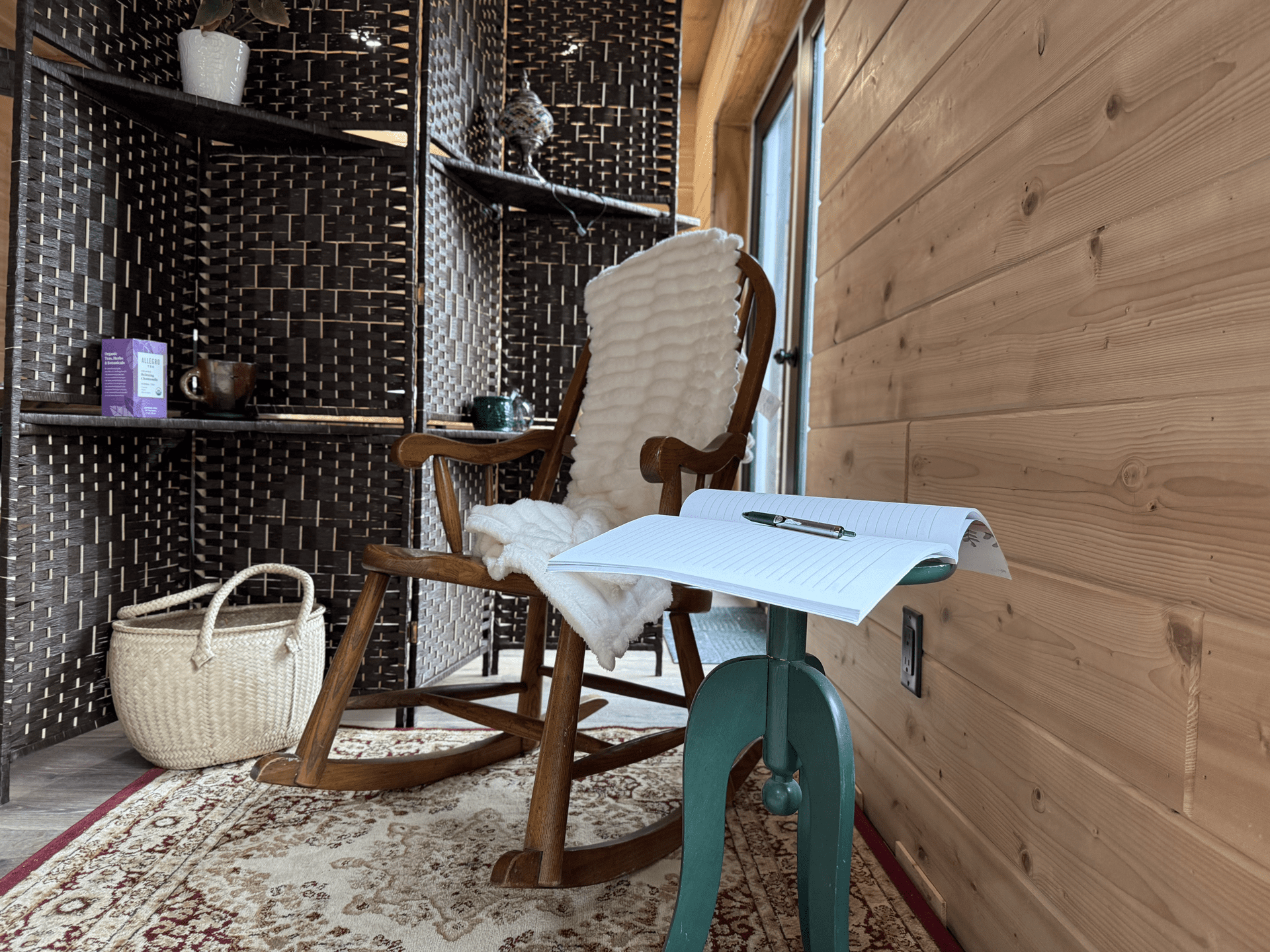
But here are a few. First is a supportive chair or cushion. Some people do prefer to sit on the floor with a cushion.
And a good chair is something important to have. But don’t worry if you don’t have right now what you think is the best chair. Think about it.
Look in different rooms in your basement, in the attic, or maybe you already have a special chair somewhere in your house. And then lighting is very important. For some of us, especially like with low vision, it’s more important than for others.
You want to look for a good, glare-free lighting source that might also be adjustable so you can focus it right on to your workbook. And then nearby, you’d probably like a reachable service so you can have a cup of tea. And one of the things that I really like now is a warmer so I can slowly drink my tea.
And if you drink any other hot drink, it’s great because you don’t have to worry about gulping it down before it gets cold. It’s also very good as a candle warmer in case that is what you would like for your personal space. And then you need a place to put in your workbook and pens and pencils or if you want to do art, your colored pencils, markers, whatever you use.
So a small basket is good for that. Any kind of tray, a little bin, anything that’s up to you. And then maybe you should have some water in reach just to stay hydrated.
And then a grounding object that pretty much designates the space like add a plant or a special photo, a soft blanket, or anything that triggers you to relax. And then if you need assistive tools, be sure you have them nearby. Those could include a magnifying glass, a thicker grip pen, a voice to text device.
And then make sure that the area has clear pathways and non-slip mats for your safety. You don’t want to get into your space and fall down or trip over something on the way.
Robert:
If mobility is limited, think about reachability. A rolling cart or bedside table can bring everything closer. If writing is difficult, a slanted surface, even a cutting board propped in a towel can help reduce the strain.
Theresa:
And remember, your space does not need to be an entire room. It can be a corner of a room, a spot at your kitchen table, or a favorite chair by a window.
Robert:
Now let’s get into some budget-friendly ideas. You don’t need new furniture. You can build a beautiful, functional space from things you already have.
Theresa:
Think of your home as a treasure chest. Maybe there’s things that you have somewhere in your house that you haven’t used for years or are saving those for, you know, the good, like the good china. Go get that out.
Make a cup of tea or coffee in your good china or favorite mug or a souvenir from some place you’ve traveled to. A serving tray or something similar like a flat basket makes a really good portable workstation. A shoebox can be your supply caddy.
Nothing needs to be fancy. If you want to get crafty, you can cover it in paper, paint it, or do whatever you like. And a sturdy hardcover book can become a lap desk.
And I did get one of these lap desks, actually trying out different things, and they will be in the show notes. I have a little lap desk. I have something, a little side tray.
I always think of a, and if anybody still has any of these, TV trays, which I don’t even know if they exist, but that would make a really good work area. It’s all up to your imagination.
Robert:
Here are some easy refreshes that make old items feel intentional instead of random. Line a tray or a box with fabric or contact paper. Add non-slip shelf liner under anything that tends to slide.
Wrap mismatched containers in the same tape or ribbon. Clean and brighten an old lamp with a fresh bulb. Fold a blanket neatly over a chair to make it feel inviting.
Use a favorite mug only during workbook time. Add a single plant or photo to anchor the space visually.
Theresa:
And really, it’s all up to you. You can make your own space. Nobody will judge it because probably nobody will be around when you’re doing your workbook or they’re in a separate space.
So, make it yours. And if you want it to feel new, unify it. Pick a color.
Blue, green, linen, purple, whatever you love. And repeat that across a few different items. Suddenly, everything will look like it belongs together.
And I might add, I actually found a sweatshirt that pretty much matches the cover of the workbook, which I had to buy it in real life. I don’t know if it looks so much like the cover. What do you think, Robert?
Robert:
It looks pretty similar, yeah. It looks pretty similar.
Theresa:
It’s similar. It’s not the exact colors, but when I first saw it, it’s like, that looks like the book cover. So, I had to get it.
Robert:
And don’t underestimate the power of cleaning something. Wiping down a tray, washing a cushioned cover, or polishing a surface can make it feel brand new.
Theresa:
And I guess I could admit here, we live in a house that, even if we’re not here, there’s dust everywhere. In fact, because we have a black toilet, I actually have to dust the toilet every now and then, which is, I guess, weird. But that’s part of the problem with black fixtures.
So, you know, clean things up. Maybe you have a fancy old lamp or an antique. You know, just wash the globe or dust or repaint or do absolutely nothing.
It’s your space. So, let’s walk through a five-step simple setup that you could do in one afternoon. And one thing I did is just look at photos, go to a place like Houzz or actually any place where you buy furniture, any kind of item, and see what kind of setup they have.
And you can kind of copy that. I know IKEA often has different room styles and things you can get. And you don’t have to go to IKEA to get those items.
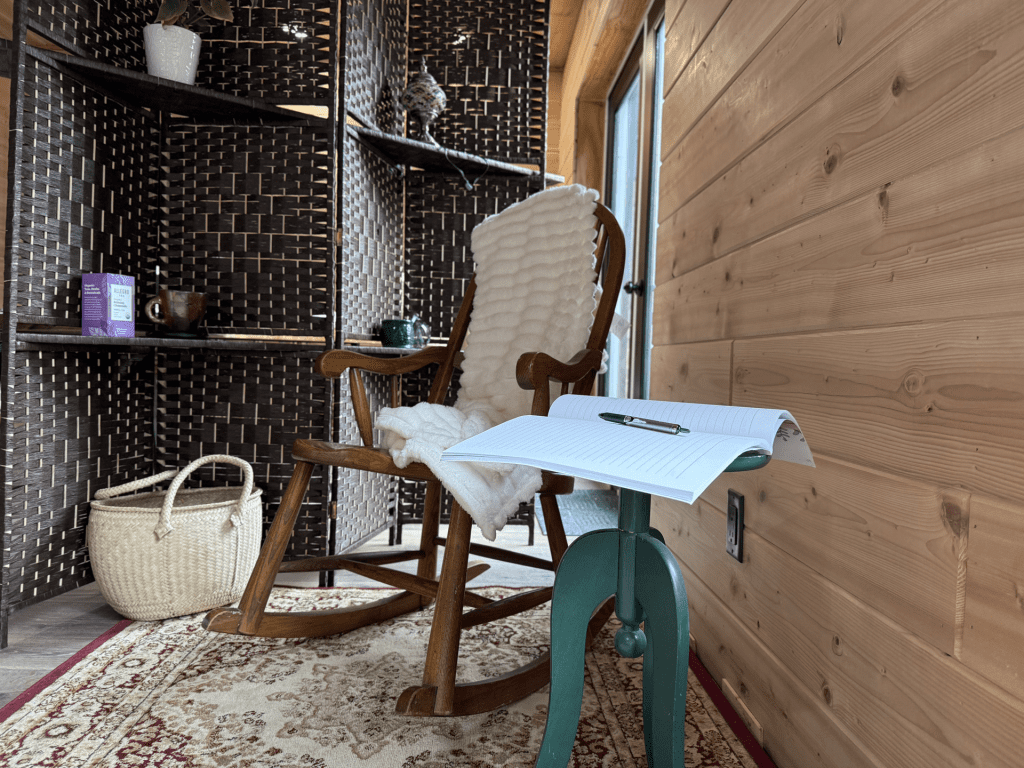
You can probably find something similar in your house. So, steal ideas from elsewhere. And speaking of that, like I said before, I’ll put up some examples of a space that we put together.
And then samples of other spaces that I adapted from one corner of a room to several different looks. So, back to the five steps. Robert, do you want to start with step one?
Sure.
Robert:
Step one, pick a spot you already like. A chair, a corner, a sunny window, anywhere you can naturally gravitate.
Theresa:
And then clear a small area. You only need enough space for your workbook and your pens and maybe something to drink.
Robert:
Step three, add essentials. A workbook, pen, glasses, water, lamp.
Theresa:
And then add something that makes you feel comfy there. Maybe you want to put on a pair of slippers. Maybe you want to sit on an extra cushion or sit on the floor on a cushion.
And a blanket, a plant, a photo. And I like to say a good view, but sometimes I get distracted by that. We have hummingbird feeders, and it’s fun just to stay and watch.
Robert:
And very distracting.
Theresa:
But they’re very distracting, but I think it also puts you in a certain state of mind that it’s so relaxing, even though it can be distracting. Maybe you need to look up from the workbook every now and then and then get back to it.
Robert:
And then step five, finally, test and tweak. Sit for a few minutes. Adjust height, light, and reachability.
Theresa:
And that’s important, and your space can be a permanent spot or it can be rather portable. Maybe you don’t have an extra chair, so you take a dining room chair or a living room chair or any kind of chair and fix it up, make it a little more decorative or different from how it already looks or always looks, and just make a spot your space and feel free to move around until you find something where you really feel part of that space. So now let’s talk about rituals and the power of a change of clothes.
And again, everything here is optional. You don’t have to do any of this. You can do all of it.
You can turn an extra room into your special space. It’s all up to you. This seems small, but let’s talk about it.
It might even be silly, but it’s actually effective. It’s a ritual item.
Robert:
This could be a soft cardigan, a shawl, a scarf, cozy socks, or a lap blanket, something you put on only during the workbook time.
Theresa:
I mean, I kind of think of this as hygge, if I said that right, the Scandinavian…
Robert:
Coziness?
Theresa:
Coziness concept. I mean, think about if you do yoga or ballet or judo, you put on different kinds of clothing, and that kind of gets you in the mindset of doing something special. So it’s not about fashion, but it could be.
If you want to dress up, that’s up to you. It’s more about signaling your brain. You’re telling it, you are entering a calmer space now, and you know what your mission is.
Robert:
And if dressing is difficult, choose alternatives. And these can be a special mug, a scented handkerchief, a soft pillow behind your back, a short playlist, or a warm lap blanket.
Theresa:
Some of us, talking about the playlist, for me, music is life, and I like to pick special music for doing different things. Sometimes it can become distracting, and I think it’s… But other times, you know, it just sits in the background.
But I do admit, oh, who’s that composer? What’s the name of the song? But that doesn’t happen too frequently.
But Robert, on the other hand, can tell you about his experience with music.
Robert:
When I was working on the house and doing things like maybe hanging drywall, things like that, I didn’t mind having music in the background. But as I’ve gotten older, I’m finding that it’s distracting and that I need to focus more on the activities, and I’m needing to check things two and three times. So I have stopped playing music whenever I’m doing something serious.
And that even includes things like writing, if I’m trying to really focus on reflecting and getting my thoughts down on paper.
Theresa:
Right, so it’s up to you. If you find music distracting, maybe white noise might be something to try if you want anything in the background. And again, it depends on your space.
Maybe you live on a busy street or a noisy area. Do what you have to do. You can always put in earplugs if you want, or headphones if you want total quiet.
And total quiet’s important to many people. Back to what we were discussing about rituals. They help your mind shift states.
They create a boundary between the busy world and your reflective time.
Robert:
And for the 70-day workbook, the consistency matters more than the intensity. Start with five minutes a day. That’s enough.
Theresa:
Anchor your workbook time to something you already do. After breakfast, after medication, maybe while the laundry’s running, or before bed. Use a gentle reminder, a sticky note, a phone alarm, or your ritual item that awaits you on your special chair.
Robert:
And remember, acceptance is not a single moment. It’s a series of small adjustments, a new cushion, a different pen, a better light. Each change is a message to yourself that you deserve comfort.
Theresa:
Before we ramp up, here are a few thoughts to carry with you.
Robert:
Small changes, steady practice. A place that welcomes you makes the work easier. Design for comfort, not perfection.
Theresa:
And there’s when you remember that Voltaire saying again, don’t let perfection ruin good enough. We’ll put a full checklist, some images of comfy workbook areas. And I do want to say that we just put the workbook up with Ingram, so it should be available at your local bookstore, maybe in your library.
If you don’t see it, just make a request for it. It is also on Amazon, and you will get a chance to see what my sweatshirt looks like. If you happen to try even one of these small changes this week, let us know how it felt.
Robert:
Your space is part of your healing. Let it be gentle, let it be yours, and let it grow with you.
Theresa:
Thanks for joining Living the Could Life. We’ll see you next week.
Robert: