Theresa:
Welcome to Living the Good Life. Today we’re going to talk about using AI to plan castle travel. And we’ve visited several castles and really had no clue how to make an efficient itinerary, so we used AI.
So the first thing you need to do is clarify what castle travel means to you. Is it fortresses, ruins, palaces, the gentle terrain, accessibility, dramatic viewpoints from a certain era of time, or those that have been turned into residences, or something else like that?
Robert:
You know, now that you mentioned, like, the dramatic viewpoints, I forget the castle that I, that the river had, was overflowing, flooding banks, and I had to walk down to get these dramatic views, which you could only get from the river, that you couldn’t see it from the land side. You had to get the views of this castle from the river, and only from there. Do you remember that?
I can’t remember the name of it, but it was a private castle that you couldn’t see from the road, that we tried getting it. Remember, we drove around trying to get to the road, and then we eventually found that there was a, I think, using AI said that you need to go down this one road, then walk across this field, and then go across this bridge. Remember that
And I did that, and the river was actually flooding part of the bridge, and I had to kind of very carefully get onto the bridge, and then I finally found, I saw the views, and I took some photographs, and then worked my way back.
Theresa:
Right, and that’s what one of the things you have to think about. Do you want to go see a ruined castle? We found ruined castles very interesting.
I guess part of it is because there was a Castle and Roberts family that is amazingly in ruins, not like other castles that we’ve seen. So you really need to decide, do you want to go see the castle for its features? If you like flowers and gardens, many of the castles have wonderful formal gardens, so that’s something to look at.
And some, even though you can’t go inside, you can still get a good view of them.
Robert:
When we were visiting some of the castles, one of the things that struck me was that some people were sort of doing castle visits kind of in a unique way. They would set up an artist easel, and they were painting the castle. Other people had sketch pads and sketch boards, and were just sketching the castle.
And so it was interesting to me that people were taking in that experience in this variety of ways.
Theresa:
Right, and that’s something really interesting, especially if you want a castle with a view, one that’s easy to paint without a lot of people interfering with your artwork, or one that has scenic overlooks, or one that’s great for photography. It’s all your choice. So when you decide, and we did this, we recently purchased a castle website that was pretty much wiki, I think, and I don’t think people would really visit it.
Our agenda is to go visit all these castles, and we looked at where they had certain castles, and we noticed there’s nothing in the Netherlands or Belgium. And we’re like, well, are there a lot of castles there? I will admit to being ignorant.
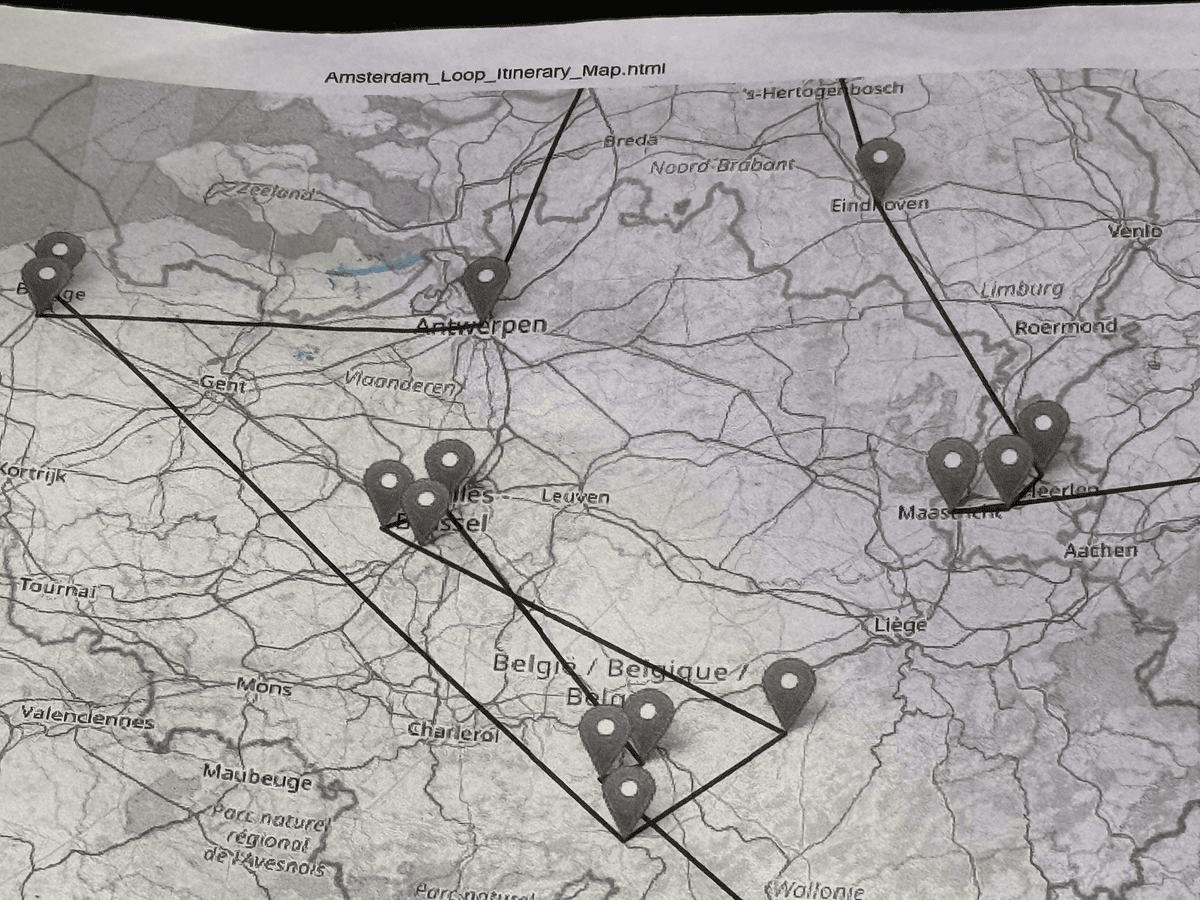
So I used AI and asked, are there castles in the Netherlands and Belgium? Assuming there would be a few, there are hundreds. We on a late December day headed to the Netherlands and Belgium and sought out a lot of castles, all different styles.
The best thing I did with AI is ask for an itinerary where we could stay in a hub and see them easily, because we did not want to be zigzagging across the country. Gas is far more expensive in Europe than it is in the US. But AI came up with some.
Doing that, I also found some good sites of other people who enjoyed visiting castles and referred to them. So one thing you do need to know is, since a lot of the castles were fortresses, they didn’t want people coming in. So a lot of them are not really accessible.
For me who can’t do the stairs or see a lot of things, I could visit the gardens, explore certain parts of the castles, and let Robert do the really hard parts with the ropes and the narrow stairs and no handrails and all that stuff.
Robert:
It was fascinating to get into some of the castle keeps and some of the towers and even into the dungeons. The stairs were, if there were stairs, they were purposely made to be able to defend so that they were not very easy to climb. Often they were very steep.
They would go in a circular pattern, but the steps would be very narrow. There were occasionally ropes that you could hold on to, and the ones that really fascinated me were the ropes that were over your head. So you had to keep your arms over your head and hold on as you walked up the steps.
So just a whole variety of ways. Also a lot of wooden staircases that had been reconstructed that took you up into the roof areas. And the roof areas were absolutely fascinating because most of the roofs had not survived either bombings from World War II or had not survived because of the weather, and they had all been reconstructed.
Theresa:
And that was another interesting thing is some of the castles like De Haar in the Netherlands was totally rebuilt on its foundation, and it was a place where the rich and famous visited. So that was fairly easy for me. They had some elevators, I believe in that one, and there are some with elevators, but you really have to search.
Where are the elevators?
Robert:
And sometimes you have to ask where are they, because they’re not really obvious, and they they’re sort of hidden around a corner in a closet or something.
Theresa:
Right, and I think they just want people who need elevators to use the elevators, not, you know, if you’re able to climb the stairs, then you climb the stairs. But I know one problem for me with low vision was like De Haar in the Netherlands, really easy to get to from Amsterdam. It was, you know, the residence for the rich and famous, and so it was easy enough for me, except for when they would have like a bed on a raised floor, and I’d get close to the barricade or the rope and not see that the floor raised.
So there were a couple times that I almost became part of the exhibit, and that is one thing a lot of the castles you can look but you can’t touch.
Robert:
They have cordons, that you can walk through from like one door in, one door out, and they have the the rooms are renovated, recreated to how they would would have looked and during a certain period. And some of the castles have like, will have spanned five, six hundred years, and the people who do the curating of the artifacts and the setting up the displays and exhibits will often just choose one particular period and keep that theme throughout.
Theresa:
And that is another thing, some castles have docents, some had someone stationed, the more popular ones like De Haar, if that’s how you say it, had people floating around. So if you looked at it funny, cross-eyed, they’d ask you to move on. And they also gave information, they might be assigned to one particular room or area.
Others, there was nobody around, and those were the ones that were, or at least claimed to be an original condition, because nothing had been done.
Robert:
Now that you mentioned that, I realized that there were a whole variety of ways that you could sort of interact with the castles and their displays and their exhibits and such, that sometimes they had a device that you could, with headphones, that you could borrow, rent, sometimes free, sometimes for a charge, and you could carry that around. And when you came to a certain numbered place, you’d hit a button or you’d hold the device up to that number and it would automatically turn on. Others had sort of audio tours that you could use from your phone, that you could download to your phone.
Some also had very large descriptions that were fairly long, fairly detailed. Some just had labels on different things. So there was a quite a variety.
And some, and like you said, the docents were there to sort of answer questions and to tell you a little bit about what was happening or what had happened in the past.
Theresa:
They also had motion detectors. So as soon as you entered a room, the music would play or the narrative would start. So it was very interesting.
Robert:
Yes, and it was interesting when some of them would have the, like, almost like a hologram or like an animated knight or a king or someone who would start talking to you. And so that was, that was well done.
Theresa:
There’s a wide variety, and of course that’s something you could ask AI, especially now that we’re telling you because we didn’t know. And they all, or most of them, have very good websites. So once you’ve figured out an itinerary, go to the CASA website.
Some are excellent, others, others not so much. And then like I said, we were concentrating at that time on the Netherlands and Belgium. We thought we might go to France, but we were there in the winter, and we found out that with a rental car, we would have to put chains or have chains to put on the car to go there, and that was some ridiculous daily fee, even if we would have only gone there for one day.
So we did not go to France or Luxembourg. But then we later went to France and picked out some castles in the Loire Valley and tried to focus on some that weren’t so well known. And recently, like in Fontainebleau, there was a big fire in the forest, but there are some incredible underrated castles, so don’t just think that you have to go to the well-known ones.
We went, we had some time before a cruise, and I think we talked about this in a previous podcast, oh we’re gonna be in Basel for the start of the cruise, let’s see what castles we could research in three days. So I asked AI where’s a good concentration of castles that we could see at least two per day. So we went way east to Bellinzona, and just that town had three all UNESCO World Heritage Sites, and we made our way back to Basel and saw other ones as well.
So then you do need to refine it, your queries for accessibility and terrain, and I’m lucky, my scene eye guy, he can do what I can’t. We were lucky in Switzerland he speaks fluent Italian, so it was a little bit crazy. We flew into Basel, took the train to Bellinzona, and saw two of the three castles.
I had used all my spoons, go back and listen to spoon theory, but he ran to the other, the last castle, just before it was closing, and he showed up speaking Italian, he’s like oh come on in.
Robert:
And she showed me the video that they play for guests, and we chatted a while, and she was very informative, and I thought I was sort of imposing staying beyond the closing time, but she wanted to keep showing me, and she wanted to hear where we were going, where we had been, so it was a very very pleasant visit.
Theresa:
And it was a very pleasant city, we stayed in a hotel right across from the station, and that’s how I chose it, when AI said oh here’s some close hotels, because we didn’t want to spend time having to take a bus or a taxi to the hotel. And what was really interesting for me, because most of these castles, except for maybe the exteriors, were not very accessible, I got to sit outside and listen to cuckoos, so that was a high point for me. I think we mentioned earlier another thing you should do is ask about the historical context.
Maybe you have relatives like Robert who had a castle, or maybe you’re interested in a certain part of history, so you could just visit those types of castles. And maybe some of them have nothing in them, a lot have programs for kids, and cafes, others are barren.
Robert:
There’s a wide variety of experiences that you can have, even the the ruins that sometimes they’re just a few stones, there might be some interpretive markers here and there, but often the castles were built at a high point, and at a very specific location, so that you need to sort of really look around, and even if it’s a ruins, it just you usually have amazing views from from these ruins.
Theresa:
And that’s so true now in the Netherlands, you know how hilly and mountainous it is, but in the Netherlands they were kind of defensive, but they were actually built to collect tolls for people who wanted to use all of the waterways. So almost every castle in the Netherlands is on a river, some kind of waterway. So that’s kind of interesting too.
Robert:
Yeah, that was the purpose of Moiderschlot.
Theresa:
Right.
Robert:
That was my first castle in Netherlands, and probably my favorite now.
Theresa:
And that’s very easy to get to from Amsterdam, if you’re visiting there, and if you go to Amsterdam website, and I think more it was one of the transport websites, I’ll put a link to it, they actually showed how you could use the different transportation passes to visit a variety of castles in the area as day trips. So that was pretty cool.
Robert:
And sometimes the public transportation doesn’t take you right up to the castle, but will take you into the town, and then you have a short, usually a very pleasant walk, through one of the nice old towns to get the castle.
Theresa:
Right, and that worked pretty well for us, and it was nice to get a feel of the town, where the castles were, that you could walk there. That was the case with Moiderschlot, or Moiderschlot, however you say it, Moiderschlot, and several other, but it’s very convenient that you could just take a train. Like we did the Netherlands castles, once with a car, once without a car, and now we are actually planning on doing some of the castles in Northern Italy, and kind of going through the same plan.
We like the hub-and-spoke system. There’s one day we may have to get a car, just because there was a good chance of getting stranded with public transportation, that was rare, or you know, I had like two trips in a day, or something. So that is our next plan, and we’re doing the same thing, and I think we can highly recommend it, and even though maybe we had glitches now and then, it was a really good way to get us in the general area, and we always had backup plans and alternatives.
I mean, if the weather was bad, we had plan B. If the castle turned out to be closed for renovations, or not open, we were in the winter, we like to travel off-season, you know, we could flip the itinerary, which works really well when you’re based in a central spot.
Robert:
We did arrive at a couple of castles that either were closed for a renovation that we weren’t aware of, or else were just not accessible, and we could take pictures from the outside, and we could sort of walk around. Castles will often have very nice grounds and parks associated, and you will often see locals who are taking advantage of that, with kids and dogs and such. So, you know, even if the castle is closed, there’s usually plenty to do in the area, and it was always a pleasant visit for us.
Theresa:
Right, and our upcoming Italy, like I said, we’re using the same hub and spoke. I will say one of the problems for me is when I do hub and spoke, or when we do hub and spoke and are staying in the same lodging, because moving around every day, that wastes a lot of time. One of my essential non-negotiables, especially when we’re staying somewhere, and I always look more for apartment hotels, but it’s very difficult to search, and AI will help, and I will say, don’t always trust AI.
Make sure it’s correct. I mean, they’re hopeful it gets you started, but sometimes it’s not always correct. But it saves hours and hours of time looking through maps.
I don’t want to sit on Google Maps for three days trying to figure out, oh, what’s the best itinerary to go from point A to B to C, and not waste time, and also have a good base. Back to one of my requirements, when we’re staying somewhere for, well, actually now that I’ve gotten older, even if it’s just one night, I do not like having the bed and one desk chair as the only seating options, and try searching for that. It’s very difficult, because some places will say, oh yeah, there’s extra seating.
Well, it’s a hard desk chair, but I highly recommend trying AI to help you if you don’t have a good travel advisor, and I know as being a former travel advisor, unless it’s a package deal, there aren’t many who could ever put together the itineraries that we have. So hope this helps you, and although we talked about castles, you can use this for any kind of travel. Thanks for listening.
See you next time, and keep living the good life.
(Transcribed by TurboScribe. Go Unlimited to remove this message.)
)