Theresa:
Some places don’t need to be sold, they just need to be shown. Southeast Alaska is one of those places. It’s a world of mist, mountains, and water that feels untouched, almost ancient.
Robert:
And tucked inside that world is the Boat Company, a small non-profit that’s been quietly, steadily protecting this landscape for more than 40 years. They don’t advertise loudly, they don’t chase trends, they simply invite people into a place they love and use travel to help save it.
Theresa:
Today, we’re talking about small ship cruising in Alaska with the Boat Company. Unlike other cruise lines you’ve heard of, they operate two small vessels, the Leesorone and the Mist Cove, each carrying just 20 to 24 guests. We sailed on Mist Cove.
It’s intimate, personal, and deeply connected to the land and water around it.
Robert:
And their mission centers on one of the most extraordinary ecosystems on Earth, the Tongass National Forest.
Theresa:
And because so many travelers don’t realize what the Tongass actually is, and some have never really heard about it, we want to pause here and give it the space it deserves. Welcome to Living the Good Life. I’m Theresa.
Robert:
And I’m your co-host, Robert. So let’s get into it. The Tongass National Forest is the largest national forest in the United States.
Nearly 17 million acres of islands, fjords, mountains, glaciers, and old-growth rainforest. It covers almost 80% of southeast Alaska and forms the U.S. portion of the largest temperate rainforest left on Earth.
Theresa:
Like Alaska, this is a giant forest. Almost everything in Alaska is much bigger than you expect, or at least it was far bigger than I ever expected. This is the forest of giants like the ancient Sitka Spruce, Western Hemlock, and Cedar.
They have stood for hundreds, sometimes more than a thousand years. It’s the old-growth forest at its best. These trees rise like pillars in a green cathedral, draped in moss and rooted in tongue.
Robert:
Beneath those trees runs water. Cold, clear, life-giving water. 19,000 miles of salmon streams braid through the Tongass.
All five species of Pacific salmon spawn here, feeding bears, eagles, wolves, communities, and entire regional economies.
Theresa:
You can’t go to Alaska without trying salmon. Wildlife thrives here in ways that feel almost mythical. Brown and black bears, the rare Alexander Archipelago wolf, Sitka black-tailed deer, and more than 350 species of birds.
Offshore, humpbacks and orcas move through nutrient-rich waters tied directly to the forest’s tail.
Robert:
The Tongass is also a global climate powerhouse. It stores more carbon per acre than nearly any forest on Earth. About 20% of all carbon in the entire U.S. national forest system. Protecting it is one of the most effective climate actions available.
Theresa:
And that is one of the missions of the Boat Company to protect the Tongass. It’s also the traditional homeland of the Tlingit, Haida, and Tsimshian peoples, whose cultures, food systems, and identities are deeply rooted in this land.
Robert:
But the Tongass is not invulnerable. Its greatest threat has always been industrial logging, especially old-growth logging. These ancient trees take centuries to grow and seconds to fall.
Once they’re gone, the ecosystem doesn’t simply bounce back.
Theresa:
And this is where the roadless rule becomes critical. The roadless rule protects more than 9 million acres of the Tongass from new road building and large-scale industrial development. When the rule is in place, these areas remain intact, but many hope for it to be lifted.
Those areas then become open to old-growth timber harvest, mining exploration and development, road construction that fragments habitat and damages salmon streams.
Robert:
Roads may sound harmless, but in the Tongass, they are the first cut. They open remote islands to logging. They increase erosion into salmon streams.
They fracture wildlife habitat. And they create long-term ecological scars that take generations to heal.
Theresa:
Climate change adds another layer of pressure to the Tongass. Warming rivers, shifting precipitation patterns, and stressing of salmon populations. The Tongass is resilient.
But even a huge rainforest has its limits.
Robert:
This is why the Boat Company exists. Not just to show people the Tongass, but to help protect it. To fund research, restoration, and long-term stewardship of one of the last intact temperate rainforests on Earth.
Theresa:
Sailing with the Boat Company did show us what a fragile environment the Tongass is. Even though it’s strong, it does have its very gentle side. It’s almost sad to hear about some of the projects planned for the area.
Definitely see it now before it turns into who knows what. The Lissarone and Miskol, they aren’t cruise ships. They’re more like floating yachts.
They have warm wood, soft light, quiet corners, and an attentive crew that knows your name and preferences by the second day.
Robert:
With only a couple dozen guests, everything feels personal. You’re not a passenger, you’re part of a small community moving through this vast wilderness.
Theresa:
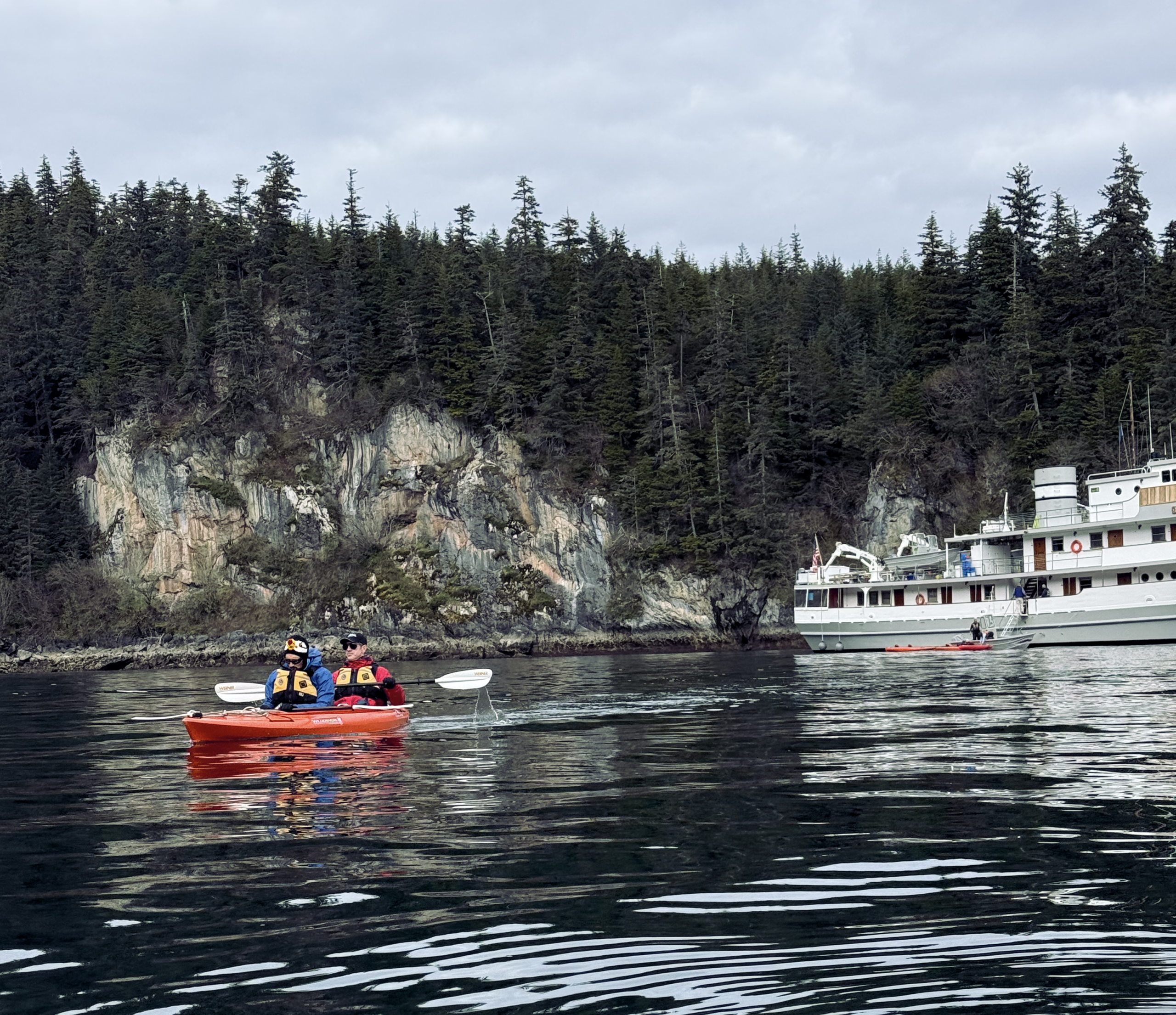
And let’s talk about the daily experience on board. The days unfold gently. There are skiff rides into quiet coves, hikes through old-growth forests, kayaking on the glassy water, watching waves surface in the distance, or seeing glacier scathe.
Robert:
The plan is usually that there’s one activity in the morning and another in the afternoon, but that itinerary flexes with wildlife and weather. If whales appear, you stop. If bears are feeding, you linger.
If the water is perfect for kayaking, they launch the kayaks.
Theresa:
The meals on board are thoughtful and unhurried, fresh seafood, local ingredients, and stories shared around the table. At the table, the meals are served family style, which was a different experience for us. I haven’t decided if I preferred that type of dining.
There’s no menu. The meals are written on a whiteboard in the dining area. Everybody sits at one huge table, and it’s a time to talk about the day or to recap what’s happened during the day.
Robert:
Now, if you have dietary restrictions or preferences, for instance, if you’re a vegan, if you need to avoid seafood, if you have other preferences, they try very hard to accommodate those.
Theresa:
They were very good at doing that, very willing to make something. If you didn’t like one of the side dishes or a certain dessert or the main course, the chef would come up with something just for you.
Robert:
There’s always a moment, usually around day 3, when you realize you’ve slowed down. You’re breathing differently. You’re noticing things again.
Theresa:
Wow, like that fresh, crisp air, the way the clouds curl around a mountain, the way a salmon stream sounds up close, and the way silence can feel full, not empty.
Robert:
And that’s the magic of the boat company. It’s not just a trip, it’s a recalibration, a reminder of what untouched nature feels like.
Theresa:
Now let’s talk a little about the accessibility for body-diverse travelers. First, this is a small, yacht-like ship. There are thresholds.
There are stairs to get into the skiffs and into the kayaks. Always the staff is there to assist, but it can still be a little bit scary, at least for me. It did take extra caution to get into both the skiffs and the kayaks.
Actually, the kayaks were far more difficult to get out of than to get into. And it did work for me, and that is also with limitations. There were areas that were extremely difficult to access.
Our cabin was on the main deck, and I recommend if you have any mobility issues, that is the best deck, because there are steep stairs to the second and third deck. The main deck is where all of the action is. If you can navigate the threshold out of your stateroom into the lounge and dining room, which also has threshold, you will do fairly well, as long as you are able to lift your legs up and over.
I would not recommend this cruise for anybody in a wheelchair. Now, a folding walker might work for you. The showers are walk-in, so if you do that with a walker, that’s a possibility.
You do not have to go on any of the excursions. Several people spent the day in the lounge or looking at the wilderness, the sea, people fishing, just from the comfort of the boat. Nothing is mandatory.
Robert:
The crew were very willing to adjust and adapt any activities to make sure that you had a very pleasant experience.
Theresa:
And in my case, I had several adaptations. One day I wanted to go fishing, but I guess I thought I’d have to stand up in one of the skiffs and didn’t think that was for me and wasn’t sure that I had the fortitude, I guess, to spend three hours fishing. I’m too much of an instant gratification person.
And that is one very interesting thing about the boat company. Fishing is an option, and it was maybe one of the most popular options. Whenever it was available, I think a majority of the passengers signed up to fish.
Some even caught fish and shipped it home. Some fish the chef used. And people just loved the fishing.
They caught different types of fish. Halibut was the one to catch. Then there was rockfish.
Robert:
There were opportunities to do both saltwater fishing and freshwater fishing. That you could take a skiff, go onto land, and there were freshwater streams. They would provide waders so that you could go into the stream and buy fish.
Theresa:
Right. And there were some avid fishermen in the group, and they brought all their own fishing equipment, including waders. So since we’re talking about some of the daily activities, besides that, we did kayaking.
If the water were rough, they did not launch kayaks. There were alternatives. I think fishing happened every single day because they were in the larger motorized skiffs, so you didn’t need any effort to get the skiff to the watering hole.
There were some hikes. I attempted a hike. We were told that one of the brothers’ islands was like a fairy tale setting full of moss everywhere.
And key for me, there were no bears. I don’t run very fast, and I might not see the bear in the first place. But I went as far as was comfortable for me.
There were a lot of roots and branches and obstructions along the way, so I just found a nice log and sat there, along with one of the staff who insisted on staying with me. We sat down there while the others hiked, and we solved all the problems of the world. And it was just a very nice, comfortable, peaceful place to be.
Robert:
And the guides were naturalists. Some of them specialized in birding, and others specialized in the mosses and the flora. It was always a very educational walk when we took the hikes.
Theresa:
Right, and every evening we had a recap of the day and learned all about what we had seen that day or what we would see the next day. I think one of the highlights for many people, and that’s besides seeing the sea lions, the seals, the otters, the bears, the whales, was going into Dawes Glacier and seeing a huge chunk of ice calf from the glacier. That was amazing.
We were in the skiffs. We waited and waited and waited. For me, I could wait three hours to watch a glacier calf, a little bit longer than I could to catch a fish.
Robert:
But the skiff journey up to the face of the glacier was fascinating because we had to dodge multiple icebergs, and we had different views of the glacier, and it really did look different from when the skiff would move from one side of the Sound to the other.
Theresa:
And we kind of figured out one of the big pieces of ice, and there were some little smaller calving, but one place started to get bluer and bluer and almost semi-transparent, looked like maybe a stained glass blue window. And sure enough, that was the piece that decided calf.
Robert:
And the different kinds of ice, it was fascinating because some of it was crystal clear. You could see right through it, and other pieces were just very white and foggy, and then there were always the blue pieces, which were fascinating.
Theresa:
Right, so everything could be adapted to your liking. And you were welcome to go up into the bridge, but that required walking up the steep staircases, which I did do a couple times. Did have double handrails, and of course Robert always helps me, but that was dicey.
If you do consider going to Southeast Alaska with the boat company, be sure to call them and ask them for advice. They know the boats very well, and they can assist you in picking a stateroom and a location. We had a bunk bed, queen at the bottom, and I guess single at the top.
We just slept in the bottom. But some of the rooms did have twin beds, especially if you don’t want to sleep with your traveling mate, it’s nice to have the option of the two single beds. Cabins were small enough, we did have an extra folding chair, we had plenty of storage space, there was a reading light above the bed, we had a screen door and a heavy wooden door in the cabins, and usually it was fairly quiet, except on the first deck, you are right above the engine room.
Robert:
The main deck sits right on top of the engine room, and several of the cabins would be right over where the anchors were released and then drawn back up, so that it was occasionally noisy. It also has a side thruster in the front of the ship, so when that was used, it was also a little bit loud.
Theresa:
But other than that, I think we were tired enough by the end of the day, and the ship always anchored in a quiet cove overnight, which was really, really nice.
Robert:
On the last day, you got to see a behind-the-scenes tour of where the crew slept, we could actually go down into the engine room, we could actually see the engines, and these had been recently rebuilt, and they were much smaller than the original engines, so there was much more room. We also got to see the galley and different storage places.
Theresa:
That was something I opted not to do, just because the engine room, I think it could be tricky.
Robert:
There were steep stairs down, and getting back up, you had to be very careful.
Theresa:
Right, and I don’t ever want to fall, so as much as I would have liked to have seen that, I did not. I think one nice place is the lounge, they have a full bar there, soft drinks, tea and coffee available all day, and that’s where people would hang out after expeditions, or if they chose not to go on an expedition, they could just sit and read, or there’s a small library there.
Robert:
There were nice viewing windows, you could always sit and watch the shoreline go by if the boat was sailing, or when it was anchored, you could easily see the shoreline. Sometimes you could walk out to the railing, and look for the charismatic megafauna, as they like to call it.
Theresa:
So who might find this challenging? We talked about this a little bit. Wheelchair users, it would be nearly impossible to even board, and if you have unsure footing, even if you use the walker on flat surfaces, it might be very difficult to board.
But again, please call the boat company, and get their expert opinion. If you need a rolling shower, maybe you should forget that. And if you can’t manage stairs at all, it won’t work for you.
But other than that, I found it okay to navigate, and I am the worst at seeing wildlife, just because they don’t see very well. But they do share pictures at the end, and most people are patient, they move skiffs around, turn them around, so that you could get close to like a starfish, for example. But all in all, I thought it was a very worthwhile experience.
And the best part is you are contributing to really the life of the Tongass National Forest.
Robert:
And it’s preservation.
Theresa:
And it is preservation. So next time, we will talk about tours by locals. We joined one of the tours in Architectural, toured in South Beach, Florida, all at a conference, and we’ll let you know what we thought of that.
If you haven’t already downloaded the workbook, or visited Amazon, please look for our very recently published workbook, a 70-day workbook for living well with body disruptions. Again, you can find it on Amazon, we’ll list it in the show notes. Until next week, thank you for joining Living the Good Life.