Disclosure:This article may include affiliate links, and some items or experiences may have been provided for review or media access. We may earn a small commission if you use these links.
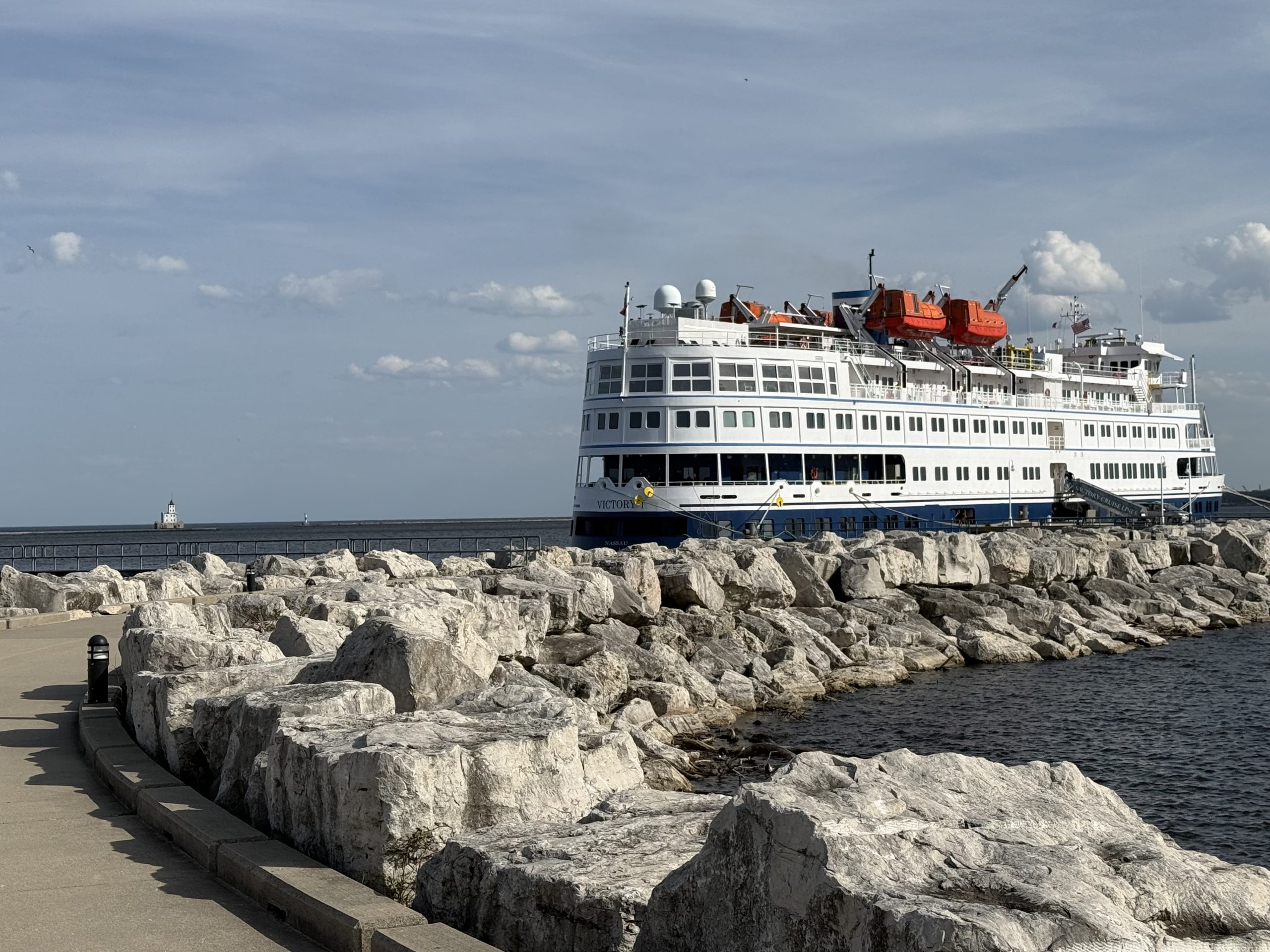
Review of the Great Lakes Cruise on Victory I
Part I – The Itinerary
In this episode, we share our opinions of Victory I as she plies the Great Lakes. We pay particular attention to accessibility.
Living The Could Life contains affiliate links. They don’t cost you anything, but we may earn a small commission if you use them. We may have been hosted on a trip, excursion or other travel-related event. We may have received or experienced a product for review. Any opinion is our own.
Transcript
Click Here for Transcript
Hi, welcome to living the good life. I’m Theresa and I’m Robert. We are sadly on the last day of our Victory One cruise along the great lakes.
We started in Toronto where Victory includes the first night at a hotel, which makes a lot of sense because many people travel, a lot of our fellow cruisers are from California and areas far away areas that aren’t on the great lakes.
Robert:
Although there are a few of us from the Midwest, we landed in Toronto and we want to focus a little bit on the accessibility needs or if there were any problems along the way. And we found navigating the Toronto airport was fairly easy. A bit of walking to finally get to the Uber pickup.
Theresa:
There was a lot of construction in Toronto. The Gardiner Highway was close, so it took us a little longer, but we did research the Westin Harbourfront Castle, which is where we stayed. It was a great location.
We did find an accessible entrance. It’s around if you’re facing the front and you are on the street because it’s a very strange entrance, like you go into a parking garage and there’s an entrance. But if you’re on the street facing the parking, you just head to the right.
And there is a sign there. But unfortunately, they want you to have a room key. If you don’t just hit the intercom button and somebody will let you in.
Robert:
The main entrance to the hotel was actually two stories up from the street level. So you had to drive up a reasonably steep driveway, I guess, up to the front doors. And that was easy enough to do.
And that’s where you would also pick up your Ubers or taxis or any other transportation if you needed to get down to the street level on the inside, you could take an elevator down two levels and then come out again, the accessibility door that’s on the, as Theresa said, on the right side, and it takes you right out to the street.
Theresa:
And we had looked for it and had a little problem. It looks like a door for the staff or unaccessible, you know, do not go beyond here. So just look when you get off the elevator.
You turn left and then it will be on your right. It’s like double doors. It is not Walmart.
Nothing says accessible.
Robert:
Once we got outside and the sidewalks were pretty clear, there were curb cuts at all of the intersections and all the crosswalks. The one thing is you really have to watch out for the bicyclists, because when you’re going across a crosswalk, there are bicycle lanes that are also going perpendicular to the crosswalk. So you have to look both ways because the bicyclists come in both directions.
And there were enough e-bikes that were moving along at a good clip.
Theresa:
Right. So that all worked out. There was a registration desk with some people representing Victory who gave us the plan.
And there were some changes. One thing about cruising anytime is be aware that flexibility is key. And I will say on this particular sailing, and this is the first one of the year, that’s always a good time for better rates.
But the weather may not be perfect. I have to say that the staff has been amazing. I would say maybe 25 to 30 percent of our fellow cruisers use some kind of mobility aid and they are well accommodated.
Many of them said they are living the good life. They’ve had hip surgery, knee surgery, health issues, and they’ve adapted. So that they can continue to travel.
Robert:
The crews provided umbrellas when we needed them, when the weather was bad. The getting onto the ship and getting off the ship required a gangway. Sometimes it was just a flat ramp.
Other times it was a stairway that was adjustable to the level of the ship down to the dock. And so and there were often an additional step or something at the bottom. The crew was extremely alert to anyone who was who had some difficulty getting on and off the ship.
And we even saw wheelchairs being carried down the ramp. So it was it was just amazing how helpful they were.
Theresa:
Yes. And there’s even wheelchairs on board the ship for your use. But it is very nice.
They have this. But never assume that you will have the same experience as we did. I mean, crews change, fellow passengers change, and fellow passengers were very helpful as well.
But always remember, it’s up to you to research. Come with the right equipment. One woman we spoke with said she usually travels with a regular rolling wheeler, the rectangular shape for traveling on a ship.
She has a foldable triangular that has a little place for her to put her things and she can fold it. So it’s very narrow. So it doesn’t take up room.
I think I wish that all cruise ships would have maybe a mobility aid that way or something, because it’s a little scary for someone like me who doesn’t see well if people leave their walker or wheelchair right in the main aisle or highway. It’s also difficult for servers like in the dining room.
Robert:
On the excursions, one thing that I noticed was that the buses, we had newer buses that followed the ship along to each port. They followed along the highways as the ship cruised to the next port and met us at each port. But the buses were kneeling buses, so the front could be lowered to adjust to like curb height and all.
They often had a stepstool at the bottom of the entry. The steps going up were reasonably steep and you had to be pretty careful going up and down in the bus. And I noticed that some of the passengers would get on the bus and actually did not get off at some of the places you could get off and sightsee and such, and that they just preferred to remain on the bus because it did take quite some effort for them to go up and down those steps.
Theresa:
And that’s a perfect alternative because on the bus, you can still look out the window and see where you are and get an idea. So you never are forced to, you know, get off the bus. The driver always stayed with the bus.
And, you know, it’s a great place just to look, enjoy the area, you know, and be reasonable and don’t think, oh, my gosh, I have to get off the bus, because you don’t.
Robert:
Our first stop after Toronto was Niagara.
Theresa:
Which actually is from Port Colborne. You don’t stop right in Niagara Falls because it’s not like you can dock a boat there. So that was really nice.
And we’ve been to Niagara many times and we never took a tour of a power station. So we did a power station tour, which took us down a hundred and eighty five feet. Was it something like that?
Robert:
It was just under 200 feet, I believe.
Theresa:
There was a half mile walk each way, but the path was clear. There’s an elevator. So if you had a wheelchair or a walker, you could do it.
The only problem was the time you had to do it, because I felt we were a little bit rushed doing that, but came out right on the bottom of the falls. And they do provide ponchos and the spray wasn’t too bad when we were there, but it was an excellent excursion and has a daily included excursion. And that was one of the included excursions.
And it was great.
Robert:
And the elevator ride was actually quite interesting because they had glass panels on one side and you could see all the inner workings of how they control the water flow through the power plant.
Theresa:
Right. So I highly recommend that. So after Port Colburn, we left and our next stop was Cleveland.
The included excursion there was the Rock and Roll Hall of Fame. As a person with low vision, I found it very difficult. It’s very dark.
If you have any kind of sensory issues, there was, I believe, a QR code on the door, but we really didn’t see an information place that told you what exactly you should do because the music goes on and on and on. Some people thought it was too loud. Others thought the music’s not interesting, which they’re lucky they’re still on the ship.
But some people did a lot, others did a little. It took us three hours just to do the first floor. And that’s because we went to the Soul Train.
I grew up in Toledo, Soul Train almost seemed like a local show and we watched it and people got to dance there. And we also went through the 13 Beatles albums, which was very interesting. You know, they talked about every album and that took a long time to get through.
Robert:
There was a video that accompanied each album and the Beatles were actually talking about what they were doing and their progress from their earliest albums to their latest ones. It was, yeah, we were, we stayed there for quite a while and went through each of the albums. There was the accompanying videos.
There are six levels in the Rock and Roll Hall of Fame. And we stayed just on the first level. There are elevators and then each, each floor does change a little bit in elevation.
There might be ramps that go up and down in certain areas, but I think it was, you know, it was all clear. There were no real obstacles.
Theresa:
No, it was good to have the elevator. So that way it was very accessible. But if you have any problems with a lot of noise or getting around when it’s dark, it can be a little difficult.
They also had an excellent Saturday night live display of all the musicians who performed and that could take an entire day. So if you do this, be sure to sign up for the earliest in the day so you can stay all day.
Robert:
Our next stop was Detroit. Um, the, we got off the ship, the people mover was not in operation. So we walked a little ways.
We got on the queue line and that was very easy. I think, I think it accommodated wheelchairs and we, it’s free and we took it and it dropped us off right at the, uh, Detroit museum of art.
Theresa:
And we had wanted to go to the Detroit Institute of art, which is also accessible. There’s elevators and you get a map. We had never seen the Diego Rivera murals, which we wanted to do.
So instead of going on the included excursion, which was the wonderful Henry Ford museum, it is not just about cars. It’s about manufacturing Americana. It’s really a nice museum.
And it was also another good choice of what to do in that port. And we had been to it and I shamefully admit, it’s probably been 50 years or more, it’s been a long time since we’ve been there, but we knew that Detroit has really good Greek because of Greek town and Mid Eastern food, because a lot of Arabs live in the area. So we went to a Greek restaurant instead of going to Henry Ford and it was well worth it for us.
Robert:
The restaurant was Pegasus and I think it was the best Greek food I have ever eaten.
Theresa:
And after Detroit, we had it North. We sailed along like here and it was a sea day. It was our only sea day.
Robert:
Lake day. Sea day?
Theresa:
Well, if you call it a lake day, I guess it’s a lake day, although the Great Lakes are inland seas, so you can call it what you want, right?
Robert:
All right.
Theresa:
But so we did that. It was interesting to learn that we don’t take the quickest route because it’s more technically difficult. And we did have a pilot on board, like the pilots change for every section that they’re in charge of.
So we got a little bit delayed. So when we got to Sault Ste. Marie, our next stop, the timing was not right to go through the locks, which is always a fun thing to watch.
But as part of that included short excursion, we went to the Valley Camp a freighter, which I worried about because of my vision and I thought it’d be crawling over a lot of thresholds and infrastructure. But, and we did see some people with walkers in there, there is a ramp so you can get up and down to the different levels of the ship.
Robert:
There were two main levels.
Theresa:
So that was really good. And it actually snowed when we were there that we weren’t expecting that, but it all worked out.
Robert:
Part of the excursion also included going to the viewing area for the locks where you had two levels that you could see the freighters going through the locks and one of the reasons we couldn’t go through the locks was apparently there was some congestion and there were too many freighters around that needed to pass through, but it was amazing to watch them go through the locks.
Theresa:
As it always is. I did it many times as a kid. There was a third option included in that free excursion.
That was to go to a Great Lakes water quality station, but we were on the later tour, so I’d recommend going on the earlier tour so that you can see all three. After Sault Ste. Marie, we went to what was a high point for many passengers and that’s Mackinac Island.
Robert:
And on Mackinac Island, the probably the most popular excursion was, which was included, was the horse carriage rides. And there are some carriages that are actually accessible that you can ask for, you can order, I guess, and they can accommodate a wheelchair. The standard carriages are designed to carry a driver and then 20 passengers in five rows, and so you’re kind of tucked in four people to each row.
Theresa:
And they are not that easy to get into. We might ask if any were accessible. I’m not sure.
Robert:
I don’t remember seeing.
Theresa:
Because they’re not easy to get into, even if you, you know, you’re perfectly able to climb up. It’s, but it’s a wonderful way to see more than just the main street of the island, it takes you to the interior. You can see the fort, you see Arch Rock, which has a great overlook, although you don’t get a lot of time there, but it gives you a really good overview of the island.
And then we did one of the premium excursions and I think they said 50 people signed up for it, which is almost half. Well, I guess it’s a third, a third of our ship, you know, it was lunching at the Grand Hotel, which is the iconic Mackinac Island building. I mean, it’s a huge Greek revival as the longest porch in the world of any building.
And it’s just magnificent. It was also chilly there. Remember we are on the first cruise of the season, just be sure to layer, pack the right things, but it was just a fantastic experience.
It is a buffet, which is never my favorite thing, but just to be in the thousand seat dining room in the wonderful decor and to explore the hotel itself was wonderful. We could go, we went up to the cupola to get photos. That’s another place.
That’s not really accessible. You can go up and then you have to walk up two sets of staircases. So that is something to consider, but there are plenty of great views from the porch.
Robert:
The Grand Hotel does sit up on a hill so that the road going up is a, is a good incline and the horse carriages slow down when they go through there. It’s walkable. There’s a nice sidewalk.
It’s beautiful. Once you get to the hotel, there are ramps. The front of the hotel has quite an imposing staircase that takes you up to the main entrance.
But on the end, facing the hotel on the right end, there’s Sadie’s ice cream parlor, and there’s a nice winding ramp that you can walk up and it will take you into the entrance for the lower level.
Theresa:
Part of what we’re doing here today is point out what you can do. And if things aren’t totally accessible, let you know how to prepare. So next we went to Escanaba in the upper peninsula, but on the North shore of Lake Michigan.
We had a wonderful excursion. I do not, I do not recall what the included excursion was.
Robert:
I think it was walking through the town. It was a walking tour through the town.
Theresa:
The town was all torn up. So we opted for an excursion that was a premium excursion that took us to a maple research facility that’s part of Michigan State University’s forestry department, and that was fascinating. We went through several plantations.
Not only do they do maple trees, they do white and red pine, willow, pumpkin, squash. They’re looking at the soil and the future of the growth of pines.
Robert:
And maple and Christmas trees, one of the more interesting research projects that they’re partnering with is looking at maple syrup that is produced both from sugar maple and from red maple. It turns out that the red maple syrup that’s produced doesn’t support microbes and the sugar maple does. And so the red maple doesn’t require the pasteurization and it has this ability to not support microbes.
It’s of interest to some cancer researchers who are looking to boost rehydration in cancer patients undergoing different kinds of therapies.
Theresa:
Great, whoever would have thought. And they do sell products and they also have an online shop. We did get, because we like pure maple syrup, as one of the other guests said, you know, they grew up in log cabin.
I think we grew up with some generic thing. They mentioned that then it was like maybe 10% real syrup and it’s just dropped down to no real maple syrup. So it’s a treat if you can find it.
And then after Escanaba, oh boy, there are some people who say, oh, if you cruise the great lakes, you don’t have to worry about seasickness. Well, they never heard of the Edmund Fitzgerald, the shipwreck graveyard, or any accidents like that. These are inland seas.
They’re not little tiny lakes. I mean, there can be humongous waves and we got to experience them last night. We were pitching from front to back and it went on for a long time.
Many people needed some medication.
Robert:
No, it didn’t bother you. And it seldom bothers you. No, I did get queasy.
Oh, we’re sitting on the top deck of Victory One and there’s a rainbow.
Theresa:
Where? Right up there. Get a picture.
Robert:
There’s a rainbow. You see? That’s kind of cool.
It’s right over the lighthouse.
Theresa:
So after a bit of a rough night with all of that pitching, it did calm down closer to morning in Milwaukee to a nice warm and sunny day. And here we selected the included excursion, which was a tour of Milwaukee. We haven’t been to Milwaukee since 2007 when we did a transcontinental bicycling tour.
And honestly, we just drove through to make the car ferry that went to Muskegon, Michigan. And so we don’t really know much about Milwaukee. So we boarded the bus.
And right near here is an art museum that was designed by Calatrava. And it does have the potential of putting a sail up, but I don’t know if you hear this. We are, you know, at a remote office on the deck of the ship.
We’ll say the wind has picked up immensely and I’m a little concerned about what the cruise will be like today. But Robert can tell you a bit about what we did.
Robert:
The entrance to the museum, as Theresa said, is actually in the shape of a sailing boat. And the sails are these long metal tubes that will fold out. They say it looks kind of like it’s too windy today to actually unfold them.
But they said when the wind is less than about 20 miles an hour, they can unfold, they can raise these tubes. And they said it has the wingspan of about a 747. So we saw some photographs of it and it’s amazing.
It’s a shame we couldn’t see it today. Our first stop was at the lighthouse. We got off the bus.
We were able to walk around, take some nice photographs. And back on the bus.
Theresa:
But you could go if you were out of the bus first. And I will say the typical guess is somebody over 50 might have some physical disruptors, as I like to call them, but still wants to travel. So getting out of the bus and I’m one of the slow ones is why I don’t want to trip up or down the steps.
But you could have gone up to the tower, the lighthouse is up there. The lighthouse itself to the very top. And there was a gift shop there and a light keepers house that you could explore.
This is the included excursion.
Robert:
Our next stop was the Pabst Mansion.
Theresa:
They told us here there was Pabst, Schlitz, Blatts, Old Milwaukee. I hope that’s all. PBR obviously still around and they offered us some as we walked into the mansion and as we left, we both politely declined.
The mansion is amazing.
Robert:
It’s one of the few mansions that are still left in this particular region. The captains of industry or the people who were helping build Milwaukee up in the late 1800s built enormous mansions. And I think they said there were like three or four of them left that.
Theresa:
Very few left, which is unfortunate, but progress, urban renewal and the like. And it was only saved because the archdiocese of Milwaukee, Uruguay, said the archbishop and others living there. So they live there 67 years.
Robert:
I think they said from 1905, after Captain Pabst and his wife died, they sold the property and the archdiocese purchased it and it became a residence for the bishops there. And I believe in 1978, it was up for sale again. And a group of women put together a historical preservation society to renovate it and to bring it back to its original splendor.
Supposedly the walls had all been painted white. They had put shag carpeting in. One of the docents there said that they use very cheap paint, the white paint.
And so it was very easy to remove from all the woodwork. And that the carpeting rolled up very easily and it actually protected the floors.
Theresa:
And it is going through some renovation, especially to the exterior. We maybe didn’t look hard enough to see if there was a ramp somewhere, because a lot of it was taped off, so you couldn’t go there, but there is an elevator in the mansion, which we use, back of the kitchen. But we weren’t sure if there’s any kind of ramp.
Otherwise you have to walk up stairs.
Robert:
We’re looking out now and there’s a freighter moving in front of us. It was being pulled by a tugboat. Do you see it?
Theresa:
We are on the fourth deck of the Victory One, and there’s a spot here. We’re the only ones here. Like we said, the wind picked up, but now it looks like we have a clear, it seems like a front one through.
It’s very nice up here. It’s like we said, our first warmer day on the whole trip. Although it was in the fifties in Toronto, which for us was warm.
Robert:
I got distracted by the freighter moving out in front of us. Our third stop was at the St. Joan of Arc Chapel that was disassembled and then reassembled on the property of Marquette University.
Theresa:
The chapel, and I didn’t really get the whole story. It first came from somewhere near Lyon, France, and it went to Long Island, and then it was rebuilt, and then it was disassembled again and moved to Milwaukee. And actually it’s only maybe the Alcove, I would call it.
That’s the original and the rest has been added onto, but it’s very pleasant. It’s more a place for meditation. They said weddings can’t happen there because it’s not a church, which I’m not up to Catholicism and what they do, but I know Catholics who get married outside.
So it was a little confusing, but it’s very, very interesting.
Robert:
It was built in 1412, I believe. And then it was added on in the 1600s and it was moved in the early 1900s, I believe the first time, and then the second time was in 1960, I believe.
Theresa:
We were told that because of this, somebody moved it, that France does not allow anybody to move anything from France anymore, brick by brick. Well, we did just drive around. We drove by the Potawatomi Casino and some of the sports venues for Marquette.
I think the Brewers.
Robert:
And we drove over several bridges, so it was actually a nice sightseeing bus ride, too, because we kept driving over these rivers and it’s lots of interesting things to see.
Theresa:
And I believe they told us there are three rivers?
Robert:
Three rivers, yes.
Theresa:
We are in a nice area, a little harbor. There’s a couple of lighthouses, a really nice itinerary to showcase the Midwest. And as we maybe mentioned before, a lot of people are surprised because they have misconceptions about the Midwest or what’s here or if it’s still like the rust belt or hasn’t grown or changed since rust belt times, especially in Milwaukee, a lot of things are gone, a lot of factories, manufacturing.
Robert:
And tomorrow we’re on our way to Chicago and we’ll get there in the morning and we’ll have breakfast, we’ll then take a river cruise, an architectural river cruise where we go up and down the river looking at the different architecture. And then we take a flight later in the day.
Theresa:
After what we considered a good cruise, one of our episodes will be about the ship itself, you know, our stateroom, the food, the itinerary, the other passengers, what’s included, what’s not, positives, negatives, anything that you might need to know. So thank you for listening to Living the Qud Life. We’ll be back next week.
Show Notes
Music
Opening Theme“Carpe Diem” by Kevin MacLeodLicensed under Creative Commons: Attribution 4.0http://creativecommons.org/licenses/by/4.0/Source: incompetech.com
Interlude:
"Ascending the Vale" Kevin MacLeod (incompetech.com)
Licensed under Creative Commons: By Attribution 4.0 License
http://creativecommons.org/licenses/by/4.0/Closing Theme“Bloom” via PixabayCC0 License (No attribution required)Source: pixabay.com/music
Mentioned in Living the Could Life
The Grand Hotel, Mackinac Island