:
Robert:
Welcome back to Living the Could Life, the podcast where we explore the world at a pace that honors your body, your energy, and your curiosity. I’m glad you’re here. I’m Robert and I’m Theresa.
Theresa:
Today we are taking you to one of Europe’s most enchanting cities, Amsterdam, and then on a slow scenic day trip to one of the best preserved medieval castles in the Netherlands, Muiderslot, and I don’t speak Dutch, so…
Robert:
This episode is especially for travelers with disabilities, chronic illness, mobility limitations, or anyone who prefers a gentler, more accessible way to explore. We’re talking public transportation, accessibility, highlights of the city, and how to reach Muiderslot by train, bus, or ferry.
Theresa:
And we’ll get into the castle’s history as well. It’s surprisingly dramatic, plus we’ll also talk about what’s accessible and what’s not at the castle, and where to eat in the charming little town of Muiden.
Robert:
So, settle in. Let’s start in Amsterdam.
Theresa:
Picture this. You’re crossing a 17th century cobblestone bridge while simultaneously eating a cone of hot fries and dodging speeding bicycles. You’re not in a museum.
You’re standing inside an open-air museum. A 750-year-old experiment that’s still unfolding.
Robert:
That’s Amsterdam. Living history with momentum.
Theresa:
You aren’t just observing the past. You’re actively trying not to get run over by it.
Robert:
The city is ancient, but wildly forward-thinking. To understand it, you have to start with the ground, or really the water, it’s built on.
Theresa:
Right, and we want to understand how a city built entirely on water mastered its incredibly challenging environment, created world-class art, and and just threw a massive year-long birthday party just to celebrate its own survival.
Robert:
This isn’t just a travel itinerary. It’s a look at urban evolution. How does a place go from a muddy swamp to a global powerhouse without losing its soul along the way?
Theresa:
And it’s a fundamental rule of urban design. Geography is destiny, and Amsterdam’s geography is its most defining feature.
Robert:
You get this immediate sensory picture when stepping into the city. It’s the narrow cobblestone streets and the trams rumbling by.
Theresa:
And the bicycles. That’s how people get around. Many people do not own cars.
There’s limited parking, and when there is, it’s expensive. So bicycles are everywhere, whether parked in large structures or whizzing past pedestrians. Exercise extreme caution when crossing roads, as most have dedicated bicycle lanes.
The locals know the rules, and they know the hazards. We’re both experienced cyclists. We would never bike in the central area.
If you want to do a bike ride, maybe ride out to Muiderslot or into the suburbs, but the locals will be cussing you out if you’re stopping every two seconds to look at a map to see where you’re going. And if you step into that bike lane, you’ll hear their bells ringing. Listen for the bells.
By doing something like stepping in front of a bike, you are disrupting their perfectly calibrated journey and the flow of traffic that has been literally negotiated over the decades.
Robert:
Let’s get back to the water. The canal system is iconic.
Theresa:
Exactly. From above, it looks like the top half, depending where you are, of a spider’s web. Concentric rings radiate outward, and those are the four main waterways in the web.
And again, excuse my pronunciation, the Singel, the Herengracht, Kaisersgracht, and Prinzengracht. You’re literally reading the city’s age and development in its rings.
Robert:
As the population swelled over the centuries, they essentially just dug new layers outward to accommodate the growth. And within those rings, you have this incredibly complex infrastructure, where canal boats navigate smaller connecting waterways and nearly 3,000 houseboats are docked.
Theresa:
They even have a dedicated houseboat museum so that you can see what living on the water actually entails.
Robert:
And the bridges. There are 160 of them crisscrossing the water, including the famous Skinny Bridge, which was originally built so narrow that it barely allowed two pedestrians to squeeze past each other.
Theresa:
Amsterdam is built on water after all, so let’s talk about those famous leaning houses.
Robert:
Since Amsterdam sits on a swampy peat, the Dutch drove thousands of massive wooden pilings through the peat into the solid sand layer below. The wood lasts for centuries, but only if it stays underwater in an oxygen-free environment. When groundwater drops and oxygen hits the pilings, rot begins and the houses start to sink.
Theresa:
Oh, and that kind of sounds like what happens to our cars here with oxidation. With all the snow and everything here in Michigan, it’s kind of the same as those houses, although we have no leaning cars here. Water management isn’t optional.
It’s survival.
Robert:
Exactly. If your neighbor mismanages their water levels, your house can sink too. That’s why Amsterdam developed a culture of deep, highly organized cooperation and pragmatic problem solving.
Theresa:
And some of their water management systems are part of UNESCO World Heritage Sites. The beating heart of Amsterdam is the Dam Square, which sometimes when there are many tourists there, I think some of the locals call it the Dam Square. Dam Square is the heart, and it is full of everything that tourists should see.
It’s quite impressive.
Robert:
Exactly. It’s where centuries of commerce, culture, and daily life collide. The Royal Palace, the New Church, the National Monument, and the Beurs van Berlage, excuse my pronunciation, a former stock exchange that was turned into a modern concert hall.
Theresa:
And surrounding all this history is the commercial area anchored by the Centraal Station, which is the main train station in Amsterdam. Beyond the station there are major shopping areas and you’re surrounded by the smells of Dutch street food. You can find those fries everywhere.
Robert:
We’re talking about grabbing a hot piece of Dutch apple pie, pancakes, or bitterballen.
Theresa:
And of course that iconic cone of Dutch fries.
Robert:
Often smothered in mayo or peanut sauce.
Theresa:
A little bit different than what we have here. Definitely worth trying. So one other section of the city is Museumplein.
It’s a nice walkable area, a good place for picnic. We were there in the winter. We saw kids learning to ice skate, which was fun to watch.
But you can also travel through history. If you look at the map you will notice, and if you visit the different sections of the city, you’ll see that all the sections are different. The pinnacle of cultural preservation is the Museumplein.
Not only are there world-class museums, but the anchor museum is the Rijksmuseum, where you’ll find Rembrandt’s Night Watch, Vermeer’s The Milkmaid, and on the top floor there’s even a World War I plane. Just because some of the artwork is famous, that does not mean that there aren’t other pieces of work that you may enjoy even more.
Robert:
Then from the Rijksmuseum you can move on to Van Gogh’s Impressionism, and then to the Stedelijk wild Fauvecolors.
Theresa:
And finally Bansky and Warhol are also found in that section of town. At the Modern Contemporary Museum it’s centuries of art all in one very walkable place.
Robert:
That density reflects Amsterdam’s history as a global trading hub and a sanctuary for ideas.
Theresa:
Let’s talk about Amsterdam’s 750th birthday. The city just ended the celebration of that birthday after a year-long celebration that ended in October of 2025. They had special things like manhole covers, banners, the light of Amsterdam, which I don’t think is working anymore, but we were lucky to see it with its eight vertical blue beams that represented the seven districts in Amsterdam plus Weesp.
And they were projected into the night sky throughout that celebration and we were lucky to see them when we took a nighttime canal cruise.
Robert:
And 10 miles of the ring road A10 highway were closed for art, music, sports, and even 400 weddings.
Theresa:
Yes, it’s modern reclamation. Just like the Dutch once bent water to their will, they’re now bending infrastructure to prioritize community and joy. And community was very important.
They had mostly for locals tours of the different districts of town.
Robert:
And it all traces back to one mundane document from 1275, granting toll privileges to the people living near the dam on the river Amstel.
Theresa:
And that simple piece of bureaucratic paperwork is, and of all in the city hall, it became the spark of a global cultural powerhouse known as Amsterdam. Amsterdam is one of the most disability aware cities in Europe. And that’s relative.
Part of it’s because it’s flat, it’s compact, and it has a public transportation system that’s genuinely designed with accessibility in mind.
Robert:
But it’s also a historic city. Narrow sidewalks, cobblestones, and bikes everywhere mean you’ll want to plan ahead. It’s a mix of very doable and take your time.
Theresa:
So taking your time is important. When we were there, we are usually the FOMO kind of people fear missing out, so we do a hundred things in one day. But we’ve changed that strategy.
It’s a good place to slow down, take your time, and just enjoy the cities and have a coffee or tea or a piece of apple pie or just people watch. So let’s start with what Amsterdam does very well. First, the transportation.
Most of the trams, buses, metro, and the ferries are accessible. Many trams have the low floor entry, the buses have fold-out ramps, and the metro is fully accessible with elevators at every station, although we found some difficulties finding the elevators.
Robert:
And English is widely spoken, which makes asking for help easier. Museums are also excellent with accessibility. The Rijksmuseum and the Van Gogh Museum are great examples.
Theresa:
In fact, there is an accessibility coordinator at the Rijksmuseum. But the challenges, cobblestones, those are always a problem. But it is a historic city, so they’re rough for wheelchairs or scooters or even people with mobility issues because they’re not all nice and flat.
They can be trip hazards. The sidewalks can be narrow with higher curbs. And some of the older buildings, especially the canal houses, they have steps going both up and down into a stairwell, which for me was a big hazard.
Robert:
But Amsterdam rewards a slower pace. It’s a city that invites you to wander, rest, and take in the beauty around you.
Theresa:
Let’s talk about how to get around using Amsterdam’s public transportation. It is run by GVB and it’s one of the easiest systems in Europe for travelers with disabilities. And when you arrive at Centraal, there is a nice tourism information center right in the station.
They’re very helpful. And now at the airport, you will find information as well, especially for trains.
Robert:
Starting with trams, the newer ones have wide doors, level boarding, and designated wheelchair spaces. Older trams still exist, but the middle door is usually the lowest.
Theresa:
And as we’ve said before, the metro is fully accessible as long as you find that elevator. They also have ramps and wide gates. If you want predictability, the metro is your friend, but there are plenty of trams and buses throughout town.
Robert:
Buses are also low floor and have fold-out ramps. And ferries, which are free, are fully accessible and a fun way to cross the Eye River.
Theresa:
As for passes, the GVB day pass is great for unlimited travel. The Amsterdam travel ticket includes the airport train and that is a huge bonus. And the Eye Amsterdam card includes museums plus the GVB transport, but not trains from the airport or outside of town.
Robert:
Let’s talk about highlights. The Rijksmuseum is fully accessible with elevators and wheelchair loans.
Theresa:
And the Van Gogh Museum is also fully accessible, though you’ll need timed entries for both of these museums and be sure to check that out for any museum that you’re visiting.
Robert:
Canal cruises are a classic Amsterdam experience, both during the day and during the night. Some companies offer wheelchair accessible boats, but not all docks are accessible, so check before booking.
Theresa:
And there is a free canal cruise offered with, I think it was the Eye Amsterdam, it’ll be in the show notes. Vondelpark is a nice great accessible outdoor space with smooth white paths. That’s a good place for strolling.
Robert:
And the Anne Frank House, this is important, is not accessible due to steep narrow stairs. They do offer a virtual tour, which is a good alternative.
Theresa:
So outside of the city, we actually recently acquired a website focusing on visiting castles. It’s called Castle Tourist and I’ll put the link into the show notes. I don’t like crowds and they’re hard for me to navigate, so we decided let’s visit castles in the Netherlands.
I think when people think of castles, they probably think of Germany, France, the UK, but who thinks of the Netherlands as a castle spot? We decided to head to Muiderslot and it happened to be open if you go off-season. Many of the castles are closed once it gets cold, but others are open all the time and some are open certain days of the week, so always check that.
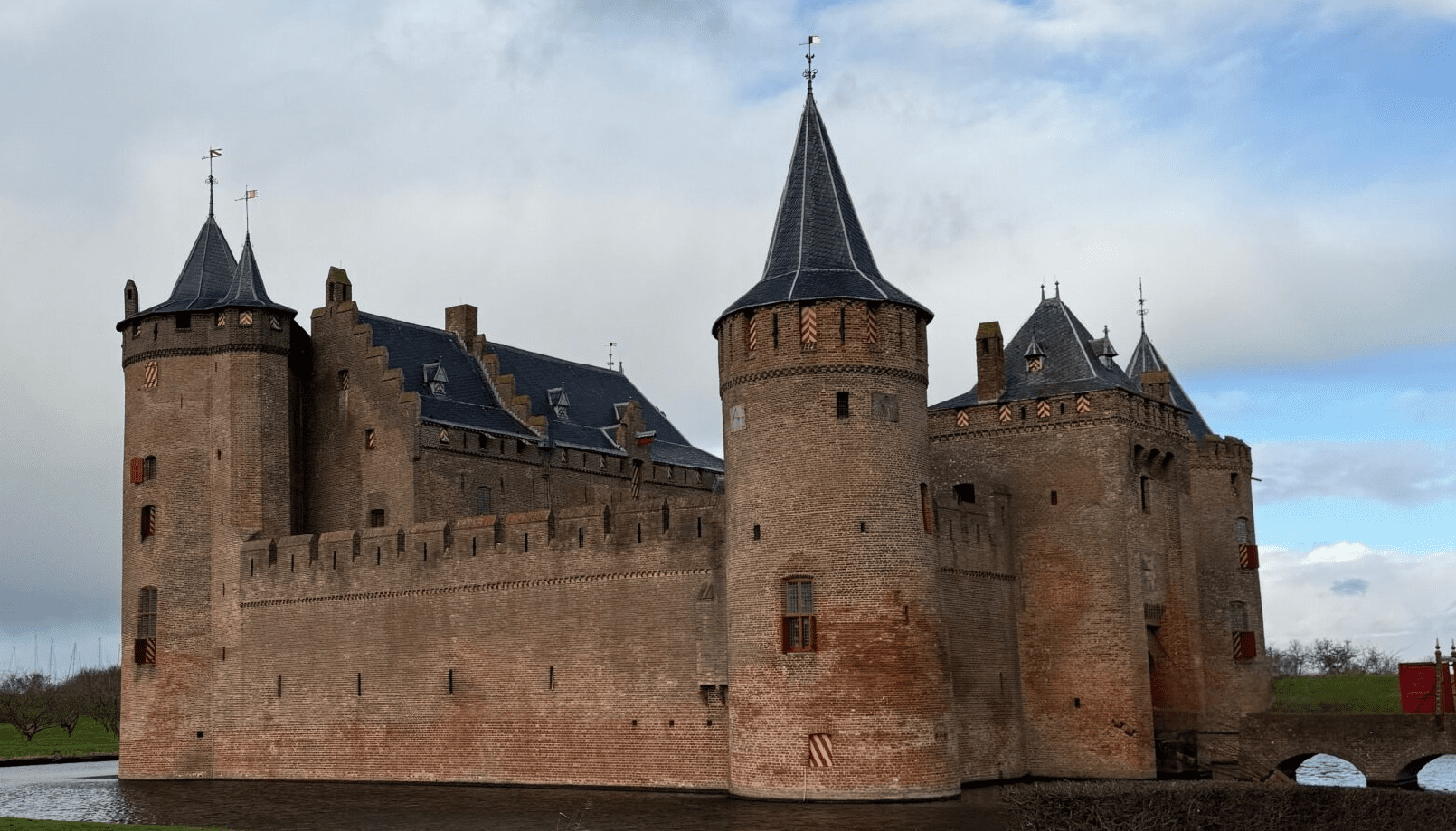
Muidersloot, or sloot, which also means castle, is also known as Muiden Castle or the Amsterdam Castle. It’s a 13th century fortress. It has towers, settlements and beautifully maintained gardens, even in the winter.
Robert:
It sits right on the water in the town of Muiden and it’s one of the best preserved medieval castles in the Netherlands.
Theresa:
And definitely worth seeing. Not too difficult to get to from downtown Amsterdam, but before we talk about accessibility, let’s talk about the castle’s history because it’s very fascinating. It goes back to Floris V, who was the person with the toll privilege.
Robert:
Muidersloot wasn’t built to be pretty, it was built to be powerful.
Theresa:
Around 1285, Count Flovis V built the original stone castle at the mouth of the river Vught. It was a strategic location. The river connected Holland, as it was then known, to the wealthy city of Utrecht.
Robert:
And Floris wanted control. Control of the river, control of the money, and control of the politics.
Theresa:
One of the castle’s main purposes was to collect tolls from merchant ships. A heavy chain could be across the river to block vessels until they paid their toll.
Robert:
So yes, it was a toll castle, but it was also a defensive fortress with thick walls, a moat, and later corner towers designed for surveillance.
Theresa:
This combination of money and military power made the castle a target. In 1296, Floris V was kidnapped and murdered nearby. Shortly after, the bishop of Utrecht seized the castle and ordered it demolished.
Robert:
It sat in ruins for about 70 years. Then around 1370, Count Albrecht of Bavaria rebuilt it on the original foundations. That’s the version we see today.
Theresa:
And we saw many castles that had a similar story, destroyed, rebuilt, and now a little, some are a little bit different than originally. Others are restored to what they would have looked like. In the 17th century, the castle had a cultural glow-up.
Poet and statesman Peter Corneliuszoon Hooft lived there and turned it into a center of art and literature, the Muiderskring.
Robert:
Later, Muiderslot became part of the Dutch Water Defense Lines, a UNESCO World Heritage System that used controlled flooding to slow invading armies.
Theresa:
Then by the 19th century, the castle was nearly demolished again for the bricks. In Robert’s family, they have a castle in northern England, which the same thing happened. It was destroyed and used for bricks and it still is there in ruins, but you can’t take any of the bricks.
Although we should attempt to do that, right?
Robert:
Right.
Theresa:
A souvenir.
Robert:
Yep. That’s interesting because the castle that was in my family, just about the same, same years, was when, when my ancestor was forced into exile and the castle was taken apart.
Theresa:
Right, I guess it’s like stealing the copper out of abandoned houses. Not much difference, right? But Moederschlacht was rebuilt bC King William I.
He and the architect Pierre Huypers, who also designed the Rijksmuseum, restored it.
Robert:
And since 1878, Muiderslot has been a state museum.
Theresa:
So let’s talk about the accessibility there. I had read that it wasn’t very accessible, and that’s the truth, but went anyway. And even if I read something, I like to find out things for myself.
So I went to the entry gate. We asked how accessible it was and they were pretty honest. So I just kind of hung out in the cafe while Robert climbed steep steps and explored.
The courtyard is accessible and the cafe there was a very pleasant place to sit for a few hours. The exterior was very nice. It was cold when we were there, so I chose to sit inside where it was a bit warmer.
And Robert went to explore and he found the stairs were steep, narrow, and necessary.
Robert:
But the good news is that the grounds are accessible. And this includes the gardens, the orchard, the outer grounds, and the tournament field.
Theresa:
And like I said, that courtyard was accessible too, but it also has stone floors, so they’re not necessarily even, so it could be hazardous. They also have, for people with visual impairments, a bronze tactile model of the castle. So you can get a real feel for the castle.
Robert:
There’s also an accessible restroom in DeTuinkamer, which is the cafe on the grounds. And wheelchair users, plus one companion, can get free entry to the grounds.
Theresa:
And that seemed to be fairly typical throughout the country, that if you have a disability that required a wheelchair, and I think, or if you had some kind of pass, but that was mostly for locals or nationals, I should say, you could get that same consideration. But they didn’t seem to think that if you have a visual impairment and need a seeing eye guy to help you around, they had no such accommodations. Let’s talk about how we got there.
Robert:
One of the most accessible ways is to take the train from Amsterdam Centraal to Weesp about 15 minutes, then take bus 110 to Muiden Centrum. From there, it’s a 10 to 15 minute walk to the castle. The walk is flat, but includes some cobblestones.
Theresa:
And it was a very pleasant walk. It was a sunny day, if I recall right. I have to look at the picture again.
And I’ll post one of those on the website. If you buy the extended pass that takes you outside of the city, they have day trips to visit castles. So there were some other castles you could visit.
I think you get to Utrecht, I think De Haar, which is another castle that was destroyed and rebuilt for the rich and famous. It was popular with Hollywood stars. And there are a few others.
And they have pretty good directions. But still, we weren’t quite sure about the transfer to the bus. And there are other buses, but some of them had a very long walk, like I believe half an hour, 45 minutes.
So we took the easiest.
Robert:
Door to door accessible taxis are also available in Amsterdam and can drop you right at the entrance.
Theresa:
There are some accessible tour operators. I believe one is called Bad Ass Tours. You would have to contact them to see if they can transport wheelchairs or things like that.
Other tours go to Muiderslot. So if you join something, just if you want to go just to be with your traveling companions, it still may be worth it. Because as we said, the outside is very nice.
Of course, I don’t know if I’d recommend that in the winter. Would you?
Robert:
It might be a little difficult in the winter. But it’s the walk around the outside is just incredible, because it has a wide moat all the way around. And it’s a very, very pleasant walk.
And it’s flat.
Theresa:
Right. It’s right on the river, which is why it collected tolls. So it’s a very scenic area.
There’s also a ferry, but that only runs between April and October.
Robert:
The ferry leaves from Amsterdam IJsberg, which you can reach by tram number 26. The ride takes about 45 minutes and is absolutely beautiful.
Theresa:
But the thing about the ferry, it is not wheelchair accessible. There are steps required for boarding.
Robert:
If you use a mobility device full time, the train plus bus route is probably the best option.
Theresa:
And another option, we all have different body changes, is to ride a bicycle. That could be a fun way to see it as well. If you’re capable, if you can see where you’re going, if you don’t have to make a lot of bathroom stops, if you just want to experience riding a bicycle in Amsterdam, that would be a good alternative.
Like we said, we were there in January. So that was an option. And then there’s a little problem that I don’t see so well.
I didn’t want to be in a canal somewhere.
Robert:
You’ll find heirloom vegetable and herb gardens, a historic plum orchard, and beautiful views over the harbor of Muiden.
Theresa:
And even when we were there in January, there were some picnic tables, because we found the weather and the temperature to be much higher than here where we live. However, the winds off the water can make it feel a lot colder than it is. But in the summer, bring some snacks or a lunch to enjoy the outdoors.
Robert:
And the on-site cafe, de Tuin Kammer, serves drinks, pastries, and light meals.
Theresa:
They make really good hot chocolate. So Moyden is small, but does have some food options.
Robert:
Cafe Omco is a classic Dutch food with waterfront seating.
Theresa:
And the Brasserie Herengracht has a great terrace and a French Dutch menu.
Robert:
And Fort H is stylish, historic, and well-reviewed.
Theresa:
And we will say these were just recommendations. We did not find anything open, maybe because it was around New Years when we were there. And we had other plans.
I mentioned before about the organized tour. They’re not usually wheelchair accessible. If you’re not comfortable going out on your own, you can sign up for one of these tours.
Robert:
Amsterdam does have companies offering accessible vans and private guided tours. Just ask about vehicle accessibility, walking requirements, and whether they can drop you at the entrance.
Theresa:
After we returned from visiting Muiderslot, we thought it would be very appropriate to go eat at a cafe restaurant in a medieval castle. And it is called Café in De Waag. I’ll put the name of that in the show.
We’ve been to Amsterdam many times and I get reminded when the tulips I got from there come up. Even though squirrels really like them too.
Robert:
And the deer.
Theresa:
And the deer. So there’s fewer of them every year, but they’re a great reminder. Even though Amsterdam is one of the easiest European cities to explore with mobility issues.
It’s not perfect, but the locals are friendly unless you jump in front of their bicycle. Very helpful. It has so much to do.
You could spend a week there and it’s a perfect place to enjoy at a slower pace.
Robert:
And Muiderslot is a perfect day trip. A medieval castle surrounded by gardens, water, and history. Whether you explore the grounds, enjoy the cafe, take the ferry, or wander the town of Muiden, this is a day that invites you to slow down and savor.
Theresa:
Thanks for traveling to Amsterdam and Muiderslot with us today. And as always, keep living the good life. The life that meets you where you are and invites you to imagine what’s still possible.
Next time we will talk about being the caretaker of someone with special needs. Caretaker for us also translates into parents. See you next time.